
If you want a direct answer: for most home growers running a 4x4 tent, a 400–500W-equivalent full-spectrum quantum board or bar-style LED hitting 600–900 µmol/m²/s PPFD at canopy is the sweet spot. That covers veg and flower without cooking your plants or your electricity bill. But getting there requires reading past the marketing and into the actual specs, so let's go through exactly how to do that, plus which lights are worth your money right now.
Best Indoor LED Grow Lights Reviews 2026: Buying Guide
Marcus Rutherford
24 Mar 2026
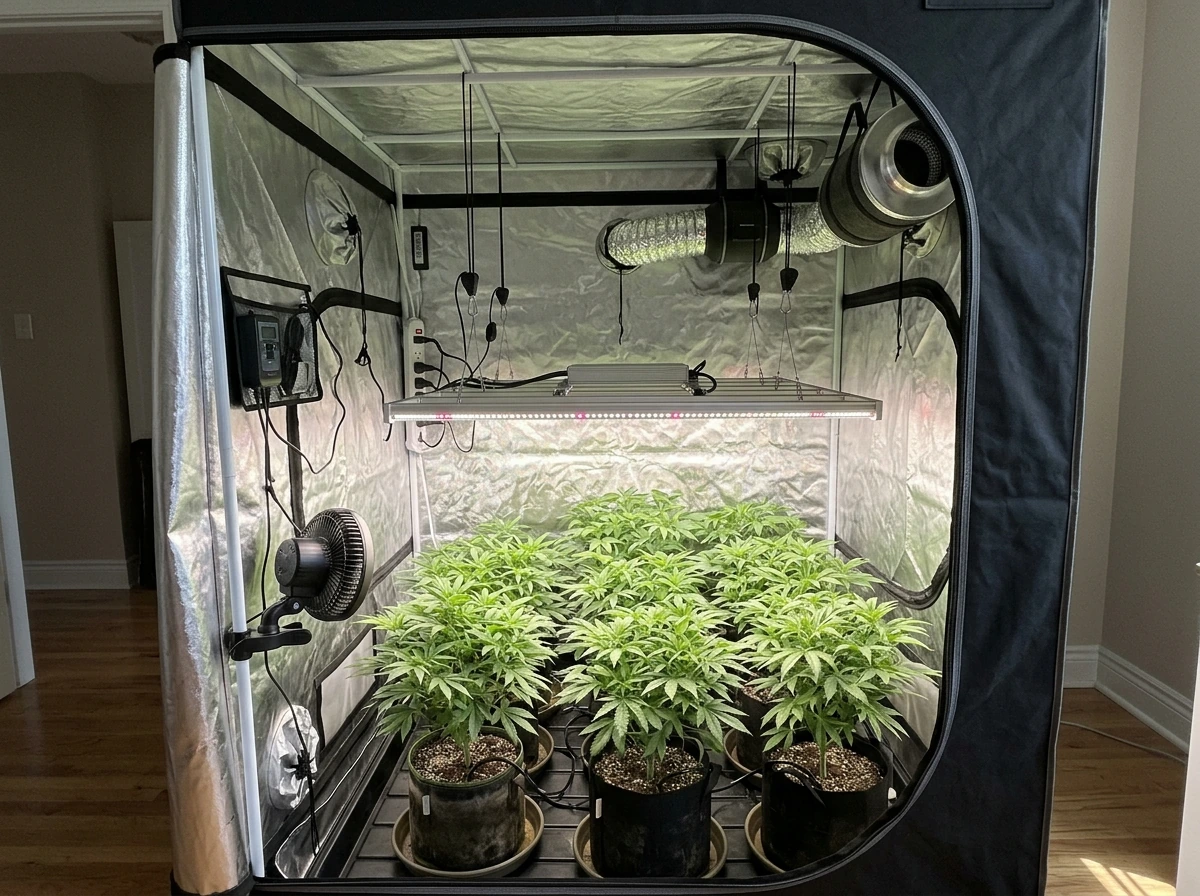
How to choose the best indoor LED grow light
The single biggest mistake people make when reading LED grow light reviews is judging a fixture by its claimed wattage. A light listed as '1200W' that actually draws 200W from the wall is not a 1200W light. Real evaluation comes down to four things: actual power draw, photon output (PPF), efficiency (µmol/J), and PPFD at the canopy distance you'll actually use. Everything else, including color temperature, chip brand claims, and coverage area marketing, should be cross-checked against those four numbers.
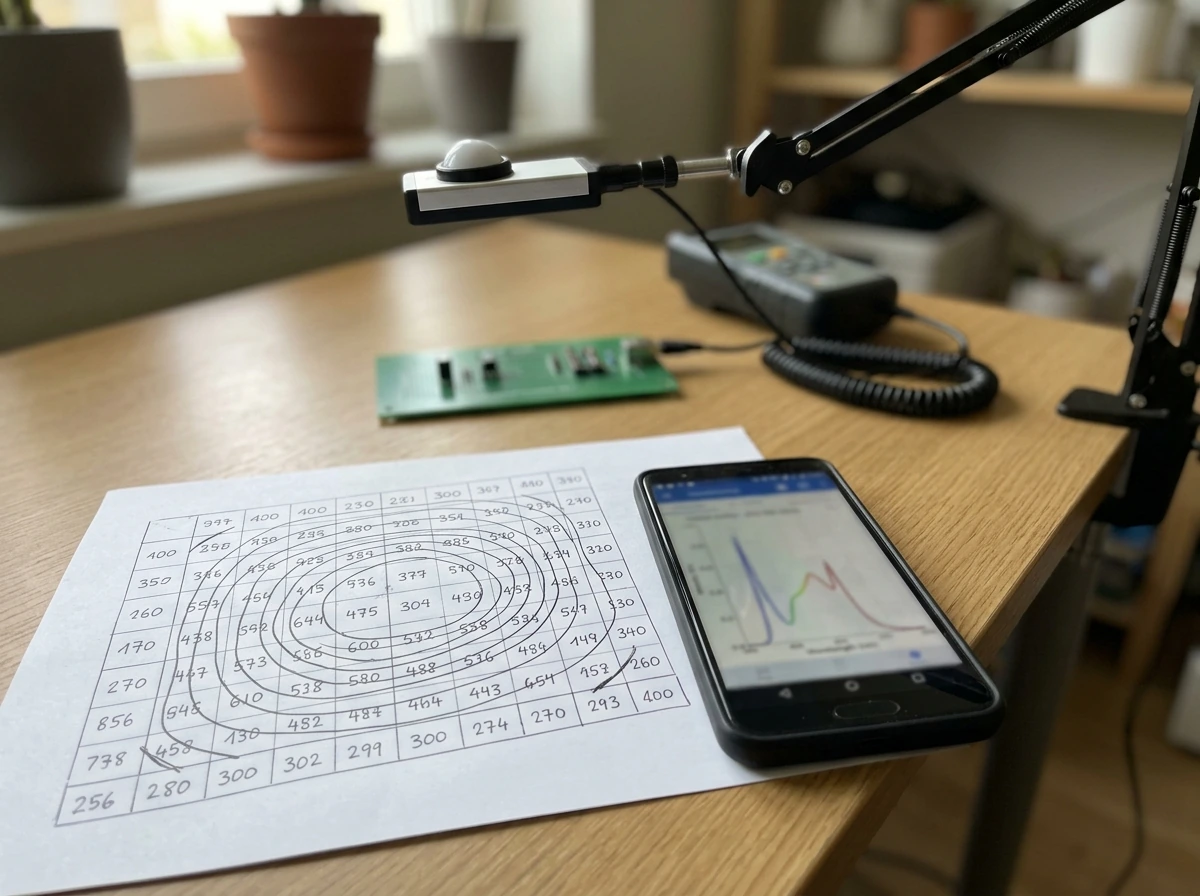
PAR charts (also called PPFD distribution maps) are the most useful tool for avoiding overpriced or underperforming lights. These charts show how photon density is distributed across a given area at a specific mounting height. A well-designed fixture has relatively uniform numbers edge to edge, not just a hot center surrounded by dead zones. If a brand won't publish a PAR map, that's a red flag. If they publish one but it only shows the center point, push harder or move on.
Efficiency matters more than most new growers realize. The practical unit is µmol/J (micromoles of photons per joule of energy consumed). Anything below 2.0 µmol/J in 2026 is outdated tech. Competitive mid-range fixtures now hit 2.5–2.9 µmol/J, and top-tier commercial bars are pushing above 3.0 µmol/J. Higher efficiency means less heat, lower electricity costs, and more photons per dollar over the life of the fixture.
- Check actual wall draw (watts), not the inflated 'equivalent' wattage in the product title
- Look for published PPF (total photon output in µmol/s) from an integrating sphere test, not self-reported estimates
- Verify efficiency in µmol/J, targeting 2.5 or higher for any fixture bought today
- Read the PPFD map at the mounting height you'll use, not the best-case distance shown in the ad
- Confirm the fixture has a relevant safety certification (UL 8800 is the horticultural-specific standard, or DLC QPL listing)
- Check warranty length and whether the driver and LEDs are covered separately
Best indoor LED grow lights by grow space and setup
The right light is determined almost entirely by your footprint. Throwing a massive fixture into a 2x2 tent wastes money and causes heat stress. Running an underpowered panel in a 5x5 gives you stretched, hungry plants. Here's how to think about it by space.
2x2 tents and single-plant setups
For a 2x2 (roughly 0.37 m²), you need something in the 100–150W actual draw range that can deliver 600–900 µmol/m²/s PPFD at around 18–24 inches above canopy. Compact quantum board panels from brands like Spider Farmer (SF-1000, drawing about 100W) and Mars Hydro (TS-1000 at around 150W actual draw) are well-documented options here. Bar-style LED strips from brands like AC Infinity work well in this space too, especially if you're running a propagation or clone rack where even light distribution matters more than peak intensity.
3x3 tents
A 3x3 (about 0.84 m²) benefits from a 200–250W actual draw fixture. At this size, bar arrays start pulling ahead of single-panel designs in terms of coverage uniformity. The HLG 225 Rspec, Spider Farmer SF-2000, and comparable bar lights in the 200W range all deliver competitive performance here. You're looking for PPF in the 500–600 µmol/s range to hit flowering PPFD targets consistently across the footprint.
4x4 tents
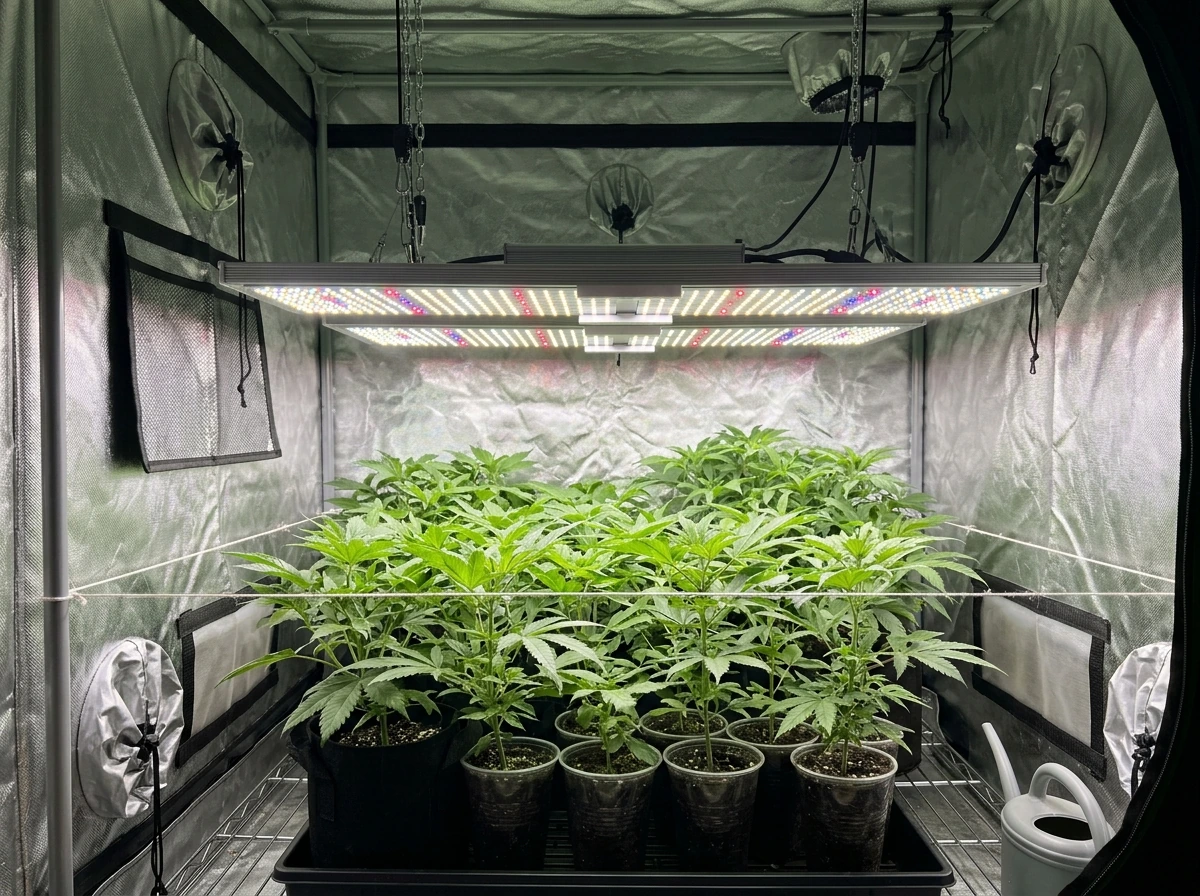
The 4x4 (1.6 m²) is the most common home grow setup, and it's where the most product options exist. You need 400–500W actual draw and PPF of roughly 1,000–1,200 µmol/s to hit the 600–900 µmol/m²/s PPFD range for flowering. The Mars Hydro FC-4800, Spider Farmer SF-4000, HLG 600 Rspec, and similar fixtures all land in this zone. Bar-style designs (multiple LED strips on a frame) generally beat single-board panels for uniformity across a 4x4 at this power level.
5x5 and larger
For a 5x5 (2.3 m²) or larger, you're looking at 600–700W actual draw or running multiple fixtures. Commercial-style bar lights like the ThinkGrow Model-I and Model-W become the right call here. The Model-W tech sheet publishes measured average PPFD values at canopy distance, which is exactly the kind of transparency you want at this price point. At this scale, fixtures with individual bar positioning let you tune coverage uniformity in ways a single-panel can't match. The MOS 600W Evo, which claims over 1,800 µmol/s total PPF and around 3.0 µmol/J efficacy, is another option worth putting on your comparison list for large single-canopy runs.
Vertical racks and multi-tier setups
Rack growing (for herbs, greens, or clone propagation) calls for low-profile strip or bar lights mounted 6–12 inches above the canopy per tier. These don't need huge PPF because target PPFD for greens and propagation sits more like 200–400 µmol/m²/s. Daisy-chainable LED strips are the standard choice here for flexibility and cost efficiency.
Full-spectrum vs. specialized LEDs: what you actually need
Most commercial LED grow lights marketed as 'full spectrum' are built around roughly 80% red and 20% blue ratios, sometimes noted as an R:B ratio of around 4:1. That's a workable baseline for most crops through veg and flower, and it's why white-spectrum quantum boards (which blend phosphor-converted warm and cool LEDs to approximate sunlight) have become the dominant design for hobbyists. They're flexible, they don't require you to manage separate veg and bloom switches, and they're easy to dial in for multiple crop types.
Specialized LEDs become relevant when you're optimizing for a specific outcome. For flowering and fruiting, deep red at 660 nm drives photosynthesis efficiently, and far-red at 730 nm plays a role in the Emerson enhancement effect, essentially making your plant's photosystems more efficient when 730 nm is paired with shorter red wavelengths. Some fixtures now include dedicated 730 nm far-red diodes alongside their main spectrum, which is genuinely useful for dense canopy penetration and speeding transition to flower in photoperiod plants.
For vegetative growth, blue wavelengths (typically 400–500 nm) promote compact, bushy structure. A fixture heavy in the blue range works well for clones and early veg, but if you're running the same light from clone through flower, a balanced white-spectrum design with supplemental red is more practical than switching between a dedicated veg light and a dedicated bloom light. The exception is if you're running a two-chamber setup where veg and flower happen simultaneously in separate spaces.
| Growth Stage | Key Wavelengths | Target PPFD (µmol/m²/s) | Recommended Spectrum Type |
|---|---|---|---|
| Propagation / Clones | Blue 400–500 nm | 100–250 | Full spectrum or blue-dominant |
| Vegetative | Blue 400–500 nm + White | 300–600 | Full spectrum white |
| Flowering | Red 660 nm + Far-red 730 nm | 600–900 | Full spectrum + red/far-red boost |
| Late Flower / Ripening | Red 660 nm + Far-red 730 nm | 700–1,000 | Red-dominant or targeted Rspec |
Wattage, coverage, and the performance metrics that actually matter
Let's nail down the terminology so you can read any spec sheet without getting confused by the numbers manufacturers choose to highlight.
PPF vs. PPFD: the difference matters
PPF (Photosynthetic Photon Flux) is the total amount of PAR light a fixture emits per second, measured in µmol/s. It tells you the fixture's total output. PPFD (Photosynthetic Photon Flux Density) is what your canopy actually receives at a specific point and distance, measured in µmol/m²/s. The relationship is straightforward: if a fixture emits 1,000 µmol/s (PPF) and all that light hits exactly 1 m², the PPFD at canopy is 1,000 µmol/m²/s. In practice, light spreads and spills, so your actual canopy PPFD will be lower than that theoretical maximum. Use PPF to compare fixtures, and use PPFD maps to confirm real canopy delivery.
Photon efficacy (µmol/J)
Efficacy tells you how efficiently a fixture converts electricity into photons. A 500W fixture at 2.5 µmol/J produces 1,250 µmol/s PPF. That same 500W at 2.0 µmol/J only produces 1,000 µmol/s. Over a 12-hour flowering photoperiod, 365 days a year, that 20% efficiency gap translates directly into electricity costs and heat load. The Longood 1000W dual-spectrum datasheet, for example, lists 2.9 µmol/J, which is competitive for its category. The MOS 600W Evo claims approximately 3.0 µmol/J, placing it near the top of commercially available options.
Coverage uniformity
A fixture that delivers 900 µmol/m²/s dead center but drops to 300 at the corners isn't effectively covering your 4x4. Coverage uniformity is best assessed through PAR charts published at your actual mounting height. Look for the ratio between the minimum and maximum PPFD readings across the footprint. A good fixture keeps that ratio tight, ideally no worse than about 70% of peak at the outer edges. Bar-style arrays consistently outperform single-panel designs on this metric because the light sources are physically spread across the footprint rather than concentrated in the center.
Wattage sizing rules of thumb
A commonly used target for flowering is around 30–50W (actual draw) per square foot of canopy, but efficiency improvements in modern LEDs have pushed this toward the lower end. With a 2.5+ µmol/J fixture, 30–35W per square foot gets you into the 600–900 µmol/m²/s flowering range for most crops. The HydroBuilder PPFD calculator uses 600–900 µmol/m²/s as its standard flowering target range, which aligns with what you'll see in most grow guides for photoperiod cannabis and high-light fruiting crops.
Review roundup: lights across budgets and form factors
Here's how the main categories of indoor LED grow lights stack up right now, across budget tiers and form factors. Prices shift, but the performance-per-dollar relationships below are representative of the 2025–2026 market.
Budget panel lights (under $150)
Mars Hydro TS and Spider Farmer SF series (lower models) dominate this tier. For the money, the SF-1000 and TS-600 deliver genuine, measurable PAR output in 2x2 to 2x4 spaces. Efficiency lands around 2.3–2.5 µmol/J, which is acceptable. The trade-off is coverage uniformity: single-board designs at this price point show significant PPFD drop-off at the edges of a 2x4. Use them in a 2x2 and they're excellent. Stretch them to a 3x3 and you'll see it in your plant growth. These are the lights where third-party lab testing from sites like GrowersHouse is particularly valuable because some products in this price band have a meaningful gap between marketing claims and measured output.
Mid-range lights ($150–$400)
This is where the market has gotten very competitive. The Spider Farmer SF-4000, Mars Hydro FC-4800, and HLG 300L Rspec all occupy different parts of this band and each has genuine strengths. The FC-4800 is a bar-style fixture, which gives it better uniformity across a 4x4 than a comparable single-board at the same wattage. The HLG 300L Rspec includes targeted red-spectrum optimization for flower, trading some flexibility for peak flowering performance. If you're growing flowering plants and staying in one space, the Rspec approach pays off. If you rotate crops or grow different plants simultaneously, a white full-spectrum design gives you more flexibility.
Dimmable lights
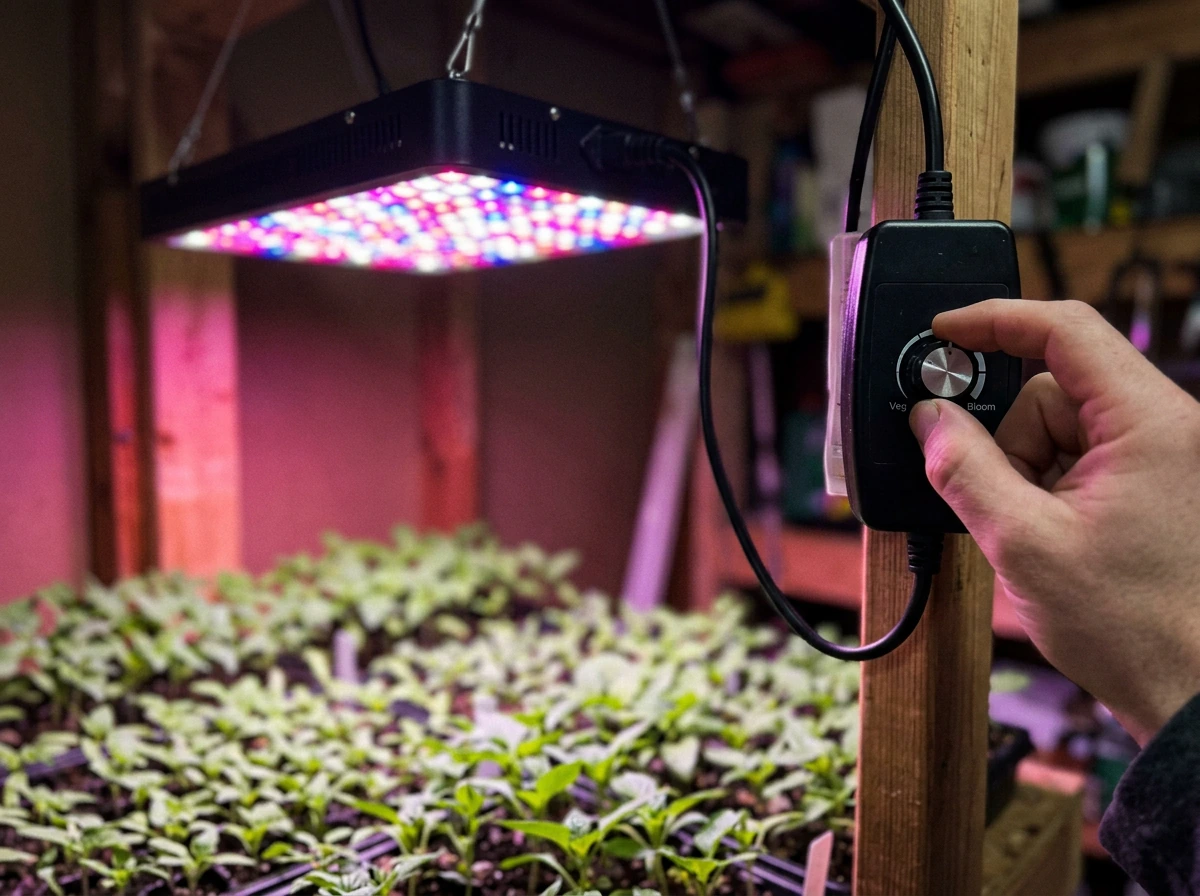
Almost every mid-range and premium fixture now includes dimming, and it matters more than marketing suggests. Running at 100% during seedling or early veg is how you stress young plants. The Growealth G4800 includes manual dimming from 20–100%, which is a useful range for managing intensity through the full growth cycle. When comparing dimmable models, check whether dimming is done by reducing driver current (which maintains efficiency per photon) or by simple PWM control (which can affect spectrum and driver temperature at low settings). Quality dimmable drivers maintain consistent spectrum across the dimming range.
Premium and commercial lights ($400+)
At the top end, ThinkGrow Model-I and Model-W are fixtures built for production environments where data transparency matters. Their published spec sheets include actual measured PPFD values at canopy distances, not just peak claims, which is the kind of documentation that justifies the price premium for a commercial build-out. The Model-W's tech sheet provides average canopy PPFD data that you can directly compare against your crop's DLI (daily light integral) targets. For anyone scaling beyond a hobbyist tent into a dedicated grow room, this is the tier worth spending in.
Greensindoor 1200W: what you're actually getting
The best led grow lights amazon shows up frequently in Amazon searches, so it deserves a direct assessment. best led grow lights amazon The fixture markets itself as using Samsung LED chips in a quantum board configuration for full-spectrum veg and flowering performance. On paper, those claims position it in the mid-range category. The things to verify before buying: the actual wall draw (the '1200W' designation is equivalent wattage marketing, not real draw), whether published PPF or PPFD data is available from a third-party test rather than internal specs, and whether the Samsung chip claim refers to the primary emitters or just certain components in the build. If the actual draw is around 200–250W and efficiency lands at 2.3+ µmol/J, it's a legitimate option for a 3x3 to 4x4 veg space. If the draw is lower and no PAR map is published, treat it as a budget fixture with budget expectations. The quantum board form factor is sound; the execution is what needs verification on this brand.
Bar-style vs. panel vs. strip: which form factor wins
| Form Factor | Coverage Uniformity | Heat Distribution | Best Use Case | Typical Price Range |
|---|---|---|---|---|
| Single quantum board panel | Moderate (center-heavy) | Concentrated | 2x2 to 3x3, single plants | $80–$300 |
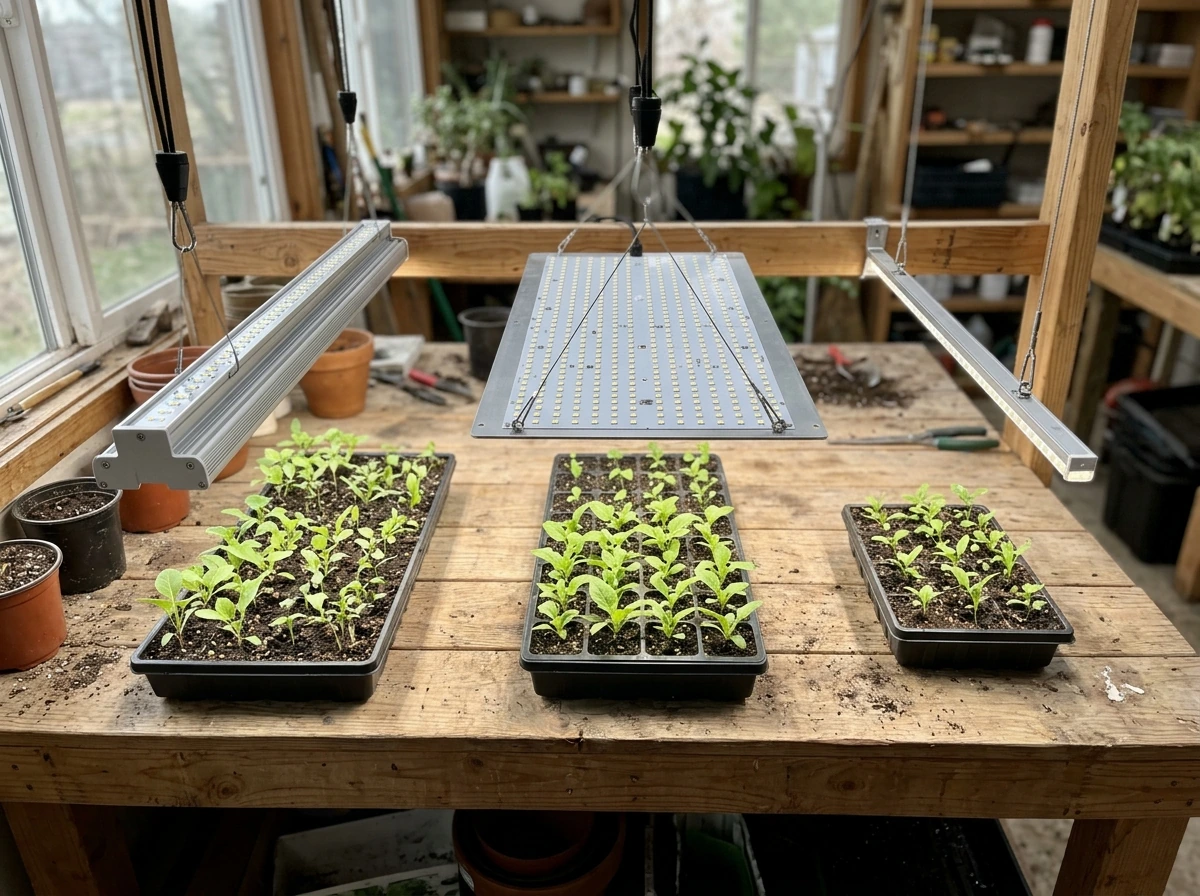
| Multi-bar / spread array | Excellent | Spread across frame | 3x3 to 5x5, flowering canopy | $200–$800+ |
| LED strip / daisy-chain | Excellent per tier | Low | Vertical racks, propagation, greens | $50–$200 |
| Commercial horticultural bar | Excellent | Optimized with passive/active cooling | Large rooms, production | $400–$1,500+ |
Installation, mounting, heat, and safety
Getting a good light is half the job. Mounting it correctly determines whether that light's specs translate into actual plant performance or problems.
Mounting height and PPFD
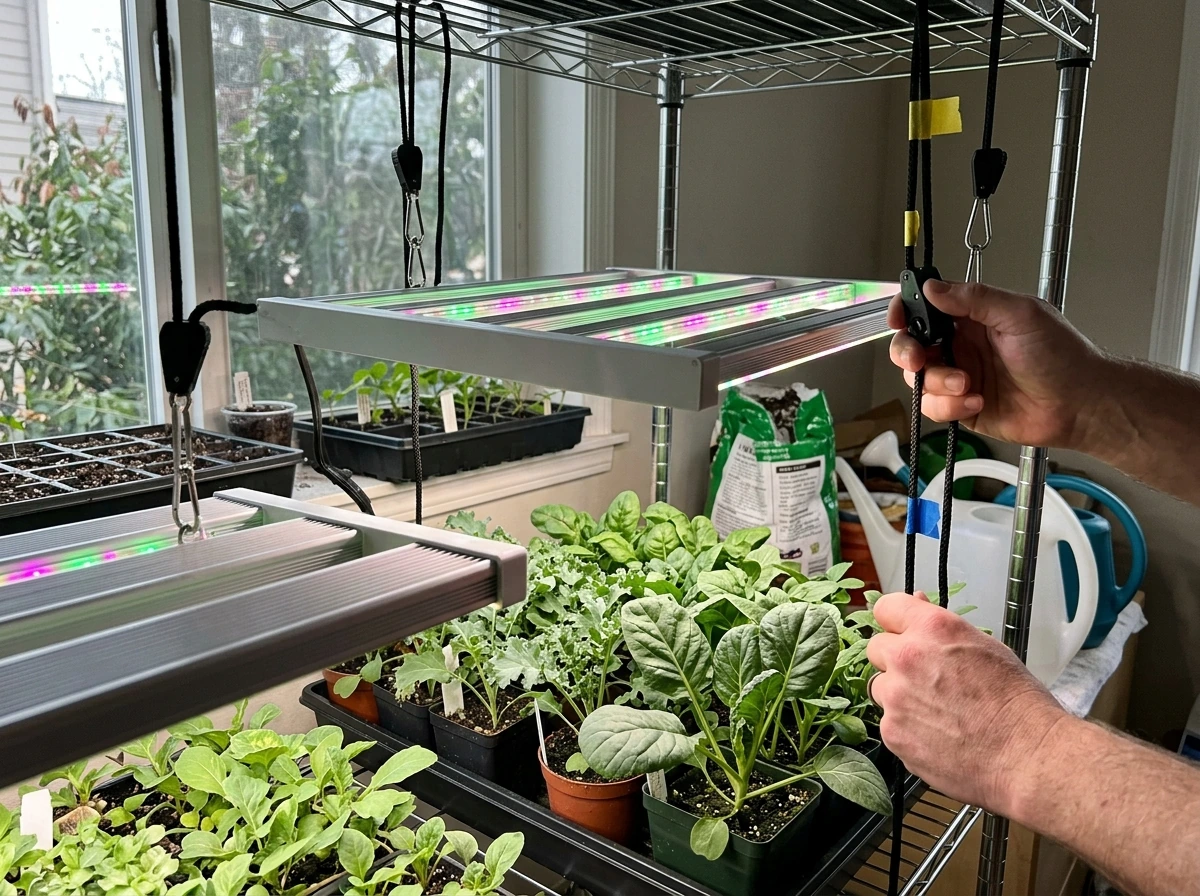
PPFD at canopy is highly sensitive to mounting height. Raising a fixture by 6 inches can cut canopy PPFD by 20–30% depending on the optics. Most manufacturers publish PPFD maps at two or three mounting heights, and that data is what you should use for initial hang height, then fine-tune with a PAR meter if possible. For flowering, target 18–24 inches above canopy for most quantum board and bar fixtures. For seedlings and clones, 30–36 inches at reduced power keeps intensity in the 100–250 µmol/m²/s range that young plants prefer.
Heat management and clearance
Modern high-efficiency LEDs generate significantly less heat than HID, but heat management still matters. Fixtures need airflow across their heatsinks, and you need adequate clearance between the fixture and the tent ceiling or grow room roof. Running a high-power fixture flush against a ceiling traps heat, raises driver temperatures, and shortens LED lifespan. Leave at least 6–12 inches of clearance above the fixture for passive convection, and make sure your tent or room exhaust fan is pulling hot air out, not just recirculating it. Sincore Lighting's guidance on this is practical: treat clearance as a fire and performance issue, not just a comfort preference.
IP ratings for humid environments
If you're running high-humidity environments (over 70% RH consistently), humidity and irrigation mist can degrade unprotected fixtures over time. Look for IP ratings on any fixture used in a wet or high-humidity space. The Growealth G4800 carries an IP65 rating, meaning it's protected against water jets from any direction. Some commercial horticultural fixtures push to IP66. These ratings matter in environments with overhead irrigation, heavy foliar spraying, or naturally high ambient humidity. For standard tent growing at controlled humidity, an IP65 fixture is more than adequate.
Safety certifications: don't skip this
ANSI/CAN/UL 8800 is the horticultural-specific safety standard for grow lights, and it's linked to DLC (DesignLights Consortium) QPL requirements. A fixture on the DLC Horticultural QPL has been tested to both performance and safety criteria relevant to grow environments, including photobiological safety (referenced under IEC 62471) and driver safety under UL 8750. Uncertified fixtures, particularly no-name imports with inflated wattage claims, haven't passed these evaluations. Grow facilities that fail to address UL 8800-level safety criteria create real risk for the space and anyone working in it. At minimum, look for UL or ETL listing. For anything above 300W actual draw in an enclosed grow space, DLC QPL listing is worth verifying.
Sizing your light, calculating ROI, and your setup checklist
Before you order anything, work through this sequence. It takes 20 minutes and saves you from buying the wrong fixture.
- Measure your actual grow footprint in square feet or square meters, not the tent's outer dimensions
- Set your PPFD target based on crop: 200–400 µmol/m²/s for greens and herbs, 400–600 for veg of high-light crops, 600–900 for flowering
- Calculate minimum PPF needed: multiply your target PPFD by your canopy area in m² (use the SANlight formula: PPFD = PPF / area, so PPF = PPFD × area)
- Find fixtures that hit that PPF target with 2.5+ µmol/J efficiency and a published PAR map for your mounting height
- Compare actual wall draw to your circuit capacity, especially if running multiple fixtures
- Check IP rating against your humidity environment and verify UL 8800 or DLC QPL certification
- Confirm dimming range if you'll run the same fixture through seedling, veg, and flower stages
- Calculate annual electricity cost: (watts ÷ 1,000) × hours per day × 365 × your kWh rate
- Compare that operating cost against premium vs. budget fixture prices to determine real ROI over 2–3 years
- Order a PAR meter or borrow one to verify PPFD at canopy after installation, then adjust height or dimmer accordingly
On ROI: the efficiency premium is almost always worth it for fixtures you'll run 12 hours a day through multiple cycles. A fixture that costs $100 more but runs at 2.7 µmol/J vs. 2.1 µmol/J pays back the difference in electricity savings within one to two grow seasons in most regions. For occasional or low-hour use, budget options close the gap more quickly. The math is simple and should drive your decision more than brand preference or spec-sheet aesthetics.
If you're still narrowing down your options, the best next steps are to cross-reference any fixture you're considering against published lab test data from independent sources, pull the PAR map for your specific tent size and mounting height, and where to buy led grow lights will be much safer if you confirm the certification status before purchasing. For specific product comparisons within narrower categories, like the best LED grow bulb for supplemental lighting or the best LED plant grow lights for small spaces, those breakdowns go deeper on the options that fit those exact scenarios.
FAQ
How do I know a light’s real power output if the brand only quotes “equivalent” wattage (example: 1200W)?
If a fixture lists “equivalent” wattage (like 1200W) but its real wall draw is far lower, your purchase decision should be based on actual draw and published PPF/PPFD. A practical check is to read the driver power rating (or confirm from reviews with wattage measurements) and ensure the product delivers the PPFD target at your intended mounting height.
What should I verify when comparing PAR maps between two LED grow lights?
PAR charts are only comparable when the test conditions match. Look for the same mounting height, same distance to canopy reference point, and the same measurement method (average vs peak, and whether the map is calibrated). If the map is missing or doesn’t state conditions, you should assume weaker edge performance and plan for a margin or choose a different model.
Is it safe to run a high-power LED at low settings for seedlings and clones?
Yes, but only if you match the dimmer behavior to your goal. Some dimming controls reduce driver current and keep efficiency stable, while others use PWM that can shift effective output at low settings. If you plan to run seedlings or clones at reduced intensity, prefer dimming that keeps spectrum consistent (or verify with user measurements and spectrum notes).
What’s the biggest mistake people make when they dim a grow light for young plants?
Do not rely on dimming alone to prevent stress. Even with dimming, if the fixture is hung too low, you can still overshoot PPFD at the center and create heat and light stress. Use the target PPFD range (lower for clones/seedlings) and adjust height first, then fine-tune with dimming to correct uniformity.
Does “full spectrum” always mean the light will perform well in both veg and flower?
“Full spectrum” can mean different channel designs. For long photoperiod grows, ensure the spectrum is balanced enough that you are not missing key red output, and if far-red is included, confirm it is actually turned on during flowering. If you want one light for veg and flower, prioritize white-spectrum boards with supplemental red rather than switching between separate veg/bloom units.
How can I prevent heat and driver overheating in a small 4x4 tent?
For a tent, typical airflow failure points are recirculating air within the tent and poor exhaust sizing. If your driver temperatures run hot, efficiency and lifespan drop. A simple prevention step is to keep a clear path for intake and exhaust, verify exhaust flow actually exchanges tent air, and confirm the fixture has unobstructed clearance for heatsink airflow.
How much does mounting height affect canopy PPFD, and how should I adjust it without a PAR meter?
Mounting height sensitivity is real, and a few inches can change edge and center PPFD differently. A good workflow is: start at the manufacturer’s recommended height for flowering, confirm with a PPFD meter if available, then adjust by small increments. If you do not have a meter, use a conservative hang height and watch for canopy uniformity issues, not just top growth.
Do IP ratings actually matter for humid grow spaces and foliar spraying?
Yes, especially if your tent gets frequent wetting, foliar spraying, or you have persistent high humidity. IP ratings help, but also check whether the power supply and connectors are protected for the same environment level. If you mist or spray overhead, choose a fixture explicitly rated for those conditions rather than assuming “indoor” protection is enough.
Should I choose a light based on wattage per square foot or based on DLI/PPFD targets?
For photoperiod flowering, your light planning should match DLI targets, not just “wattage per square foot.” Use the fixture’s PPFD at canopy distance to estimate DLI for your schedule, then confirm it stays within your crop’s target range. This prevents buying a light that hits the right peak PPFD but not the right total daily light.
Are bar-style LEDs always better than quantum boards for tent grows?
In many cases, a bar-style array can be easier to dial in for uniformity because sources are distributed across the footprint. But it depends on the specific reflector/optics and how the bars are positioned. If you mainly grow one canopy level and want consistent edge performance, bars are a strong default; if you are limited by height or want a simpler single-point layout, quantum boards can work well at smaller footprints.
What changes when choosing lights for a multi-tier rack or propagation bench?
For multi-tier rack growing, do not assume the same mounting height and PPFD as a single canopy. You generally want lower PPFD per tier, more even overlap, and careful spacing to avoid the top tier stealing light from the tier below. Plan each tier’s target PPFD, then choose fixtures designed for vertical mounting or use daisy-chainable strips that allow per-tier placement.
When is a higher efficiency fixture not actually the best value?
A higher µmol/J is usually worth it for lights you run many hours. But ROI can flip if you oversize the fixture or run it at excessive power to compensate for poor uniformity. Before paying a premium, confirm the light meets your canopy PPFD targets across the whole footprint, then compare electricity cost based on actual wall draw and your daily schedule.
What safety checks should I do beyond “it has a UL sticker”?
Safety verification matters, especially for high draw fixtures in enclosed spaces. Besides UL or ETL listing, look for horticultural grow-light testing aligned with the relevant standards and confirm you are buying from a brand with traceable documentation. If the listing is missing or unclear and the watt claims are aggressive, treat it as higher risk.
What should I do if a grow light’s marketing sounds great but it won’t publish PPF/PPFD data?
If a light is missing published PPF, PPFD, or a PAR map, assume you cannot rely on specs alone. The next step is to either request the data from the seller, buy only from brands that publish measurable maps, or rely on independent lab/review testing that includes PPFD measurements at your height. Otherwise, budget for a dimmer and possibly for adding supplemental lighting.
Next Articles
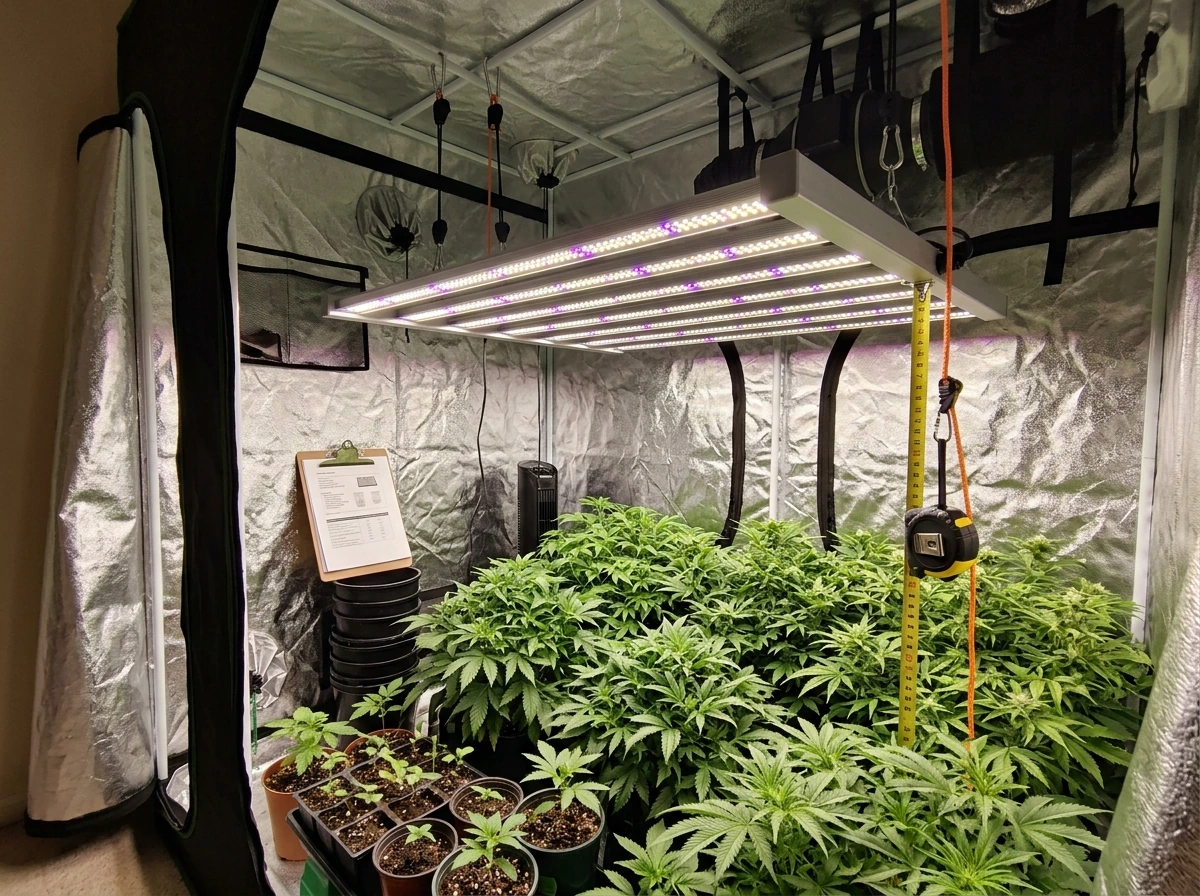
Best LED Grow Lights on Amazon: Buying Guide for Any Setup
Step-by-step guide to choose the best Amazon LED grow lights by PPFD, coverage, wattage, height, spectrum, and safety.
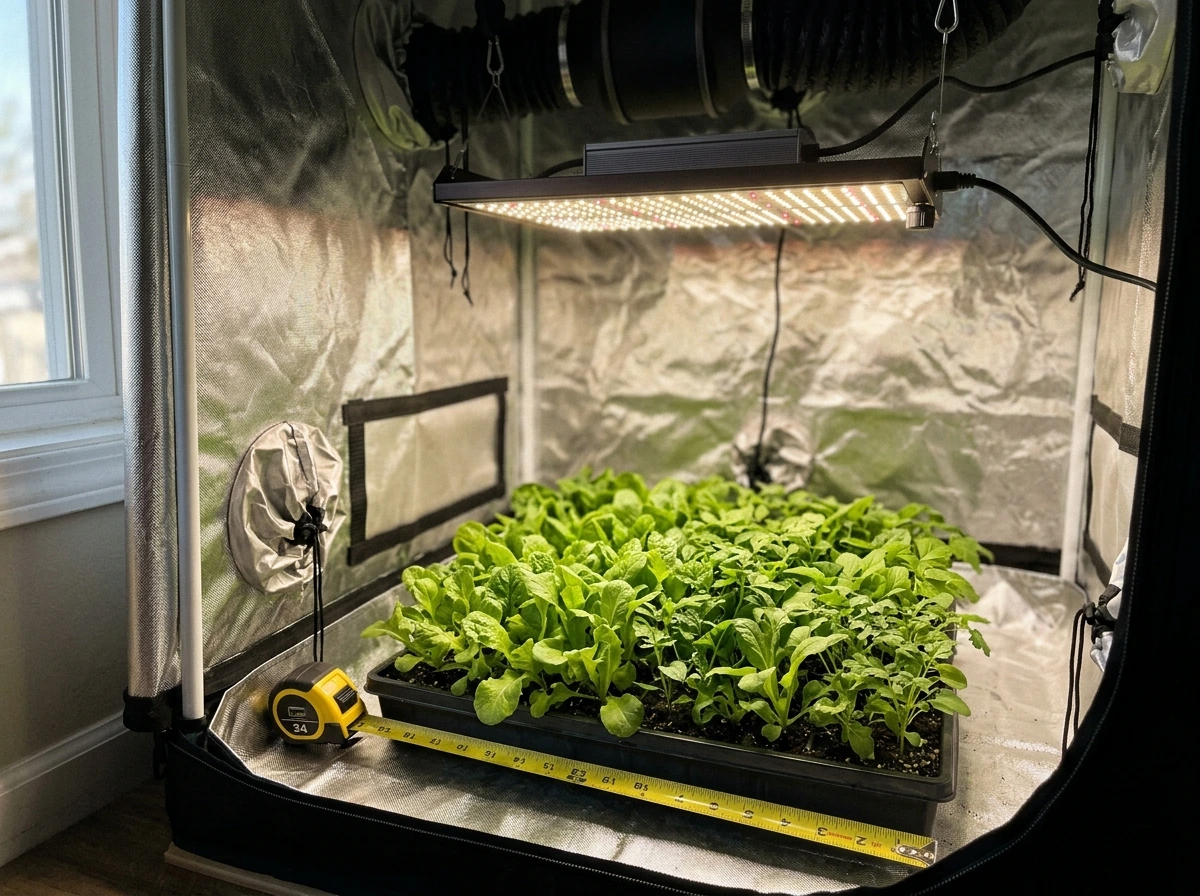
Best LED Plant Grow Light: Buying Guide by Grow Space
Best LED grow light buying guide by grow tent size: PPF/PAR specs, coverage, spectrum, dimming and plant match.
Top LED Grow Lights 2020 Buying Guide for Today
Top LED grow lights 2020 guide: pick the right spectrum, coverage, and wattage for tents or multi-panel setups.