The [best LED grow light](/commercial-led-grow-lights/best-indoor-led-grow-lights-reviews) for your setup is the one that delivers the right amount of photosynthetically active radiation (PAR) across your actual canopy, not just the one with the biggest watt number on the box. That distinction matters more than anything else in this guide. Wattage is a power consumption figure, not a performance figure, and buying by watts alone is the fastest way to overspend or underperform. Once you understand what PAR, PPF, and efficiency actually mean, picking the right fixture becomes a lot more straightforward. best american made led grow lights
Best LED Plant Grow Light: Buying Guide by Grow Space
Marcus Rutherford
24 Mar 2026
How to Choose the Best LED Grow Light for Your Goals and Space
Before you look at a single product, answer three questions: How much space do I need to cover? What plants am I growing, and what light intensity do they need? And what is my realistic budget, not just to buy, but to run the light over a full grow cycle? Those three answers filter out probably 80% of the options immediately.
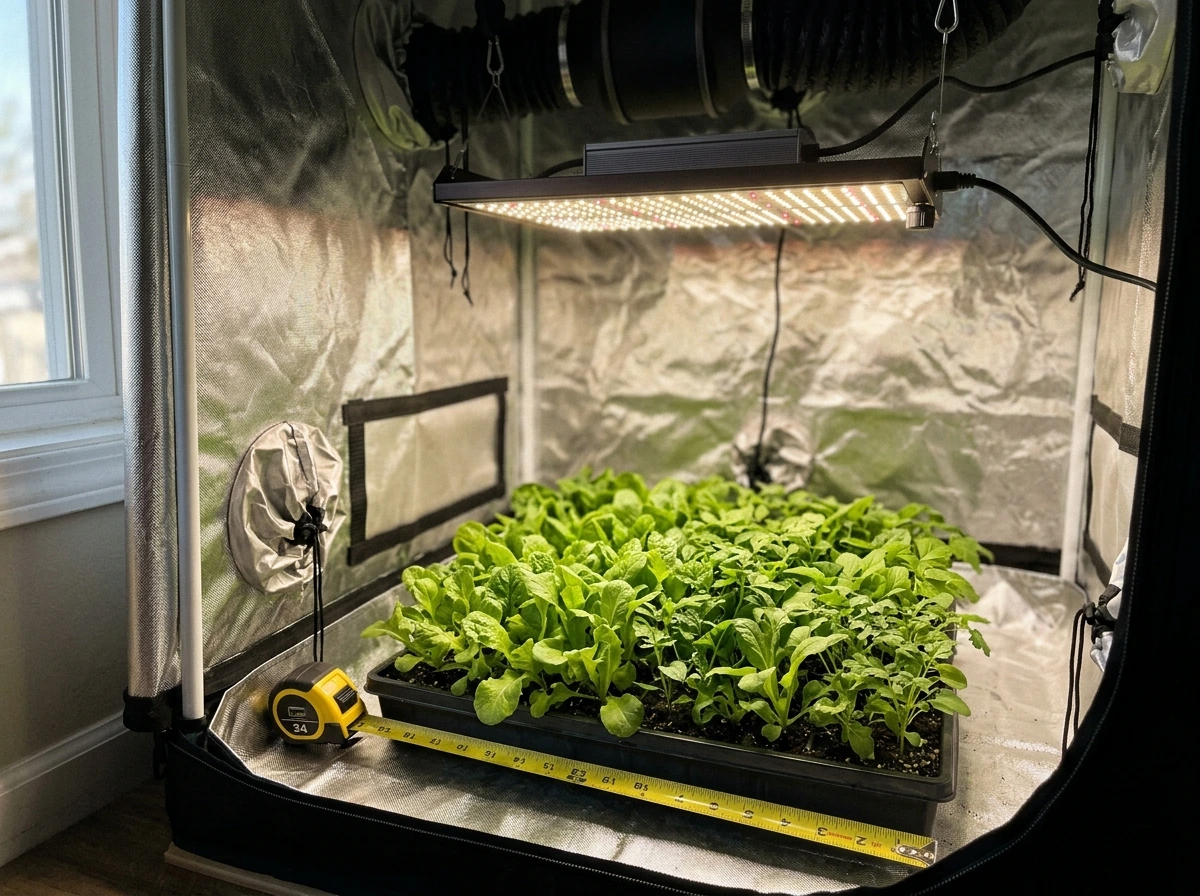
Grow space drives everything. A 2x2 tent for herbs and seedlings has completely different requirements than a 4x4 tent running fruiting plants like tomatoes or cannabis. More space means more photons needed, which means more watts consumed, more heat to manage, and more money spent on electricity. If you undersize a light, you will see stretched, light-starved plants. If you oversize it without dimming control, you risk light burn and wasted power.
Plant type is the second filter. Leafy greens, herbs, and seedlings thrive at lower daily light integrals (DLI), typically in the 12 to 20 mol/m²/day range. Fruiting plants like peppers, tomatoes, and high-demand crops push toward 30 to 45 mol/m²/day or more. A fixture that is perfect for a lettuce setup will leave your tomatoes hungry. Understanding your target DLI before you buy saves you from making a second purchase six months later.
Budget is the third factor, and it has two components: purchase price and operating cost. A cheap 100W panel at 1.5 µmol/J efficiency will cost you significantly more in electricity over 18 months than a premium fixture hitting 2.7 µmol/J at the same output level. Run the math on your local electricity rate before deciding that the cheaper light is actually cheaper.
Best LED Grow Lights by Tent Size and Canopy Coverage
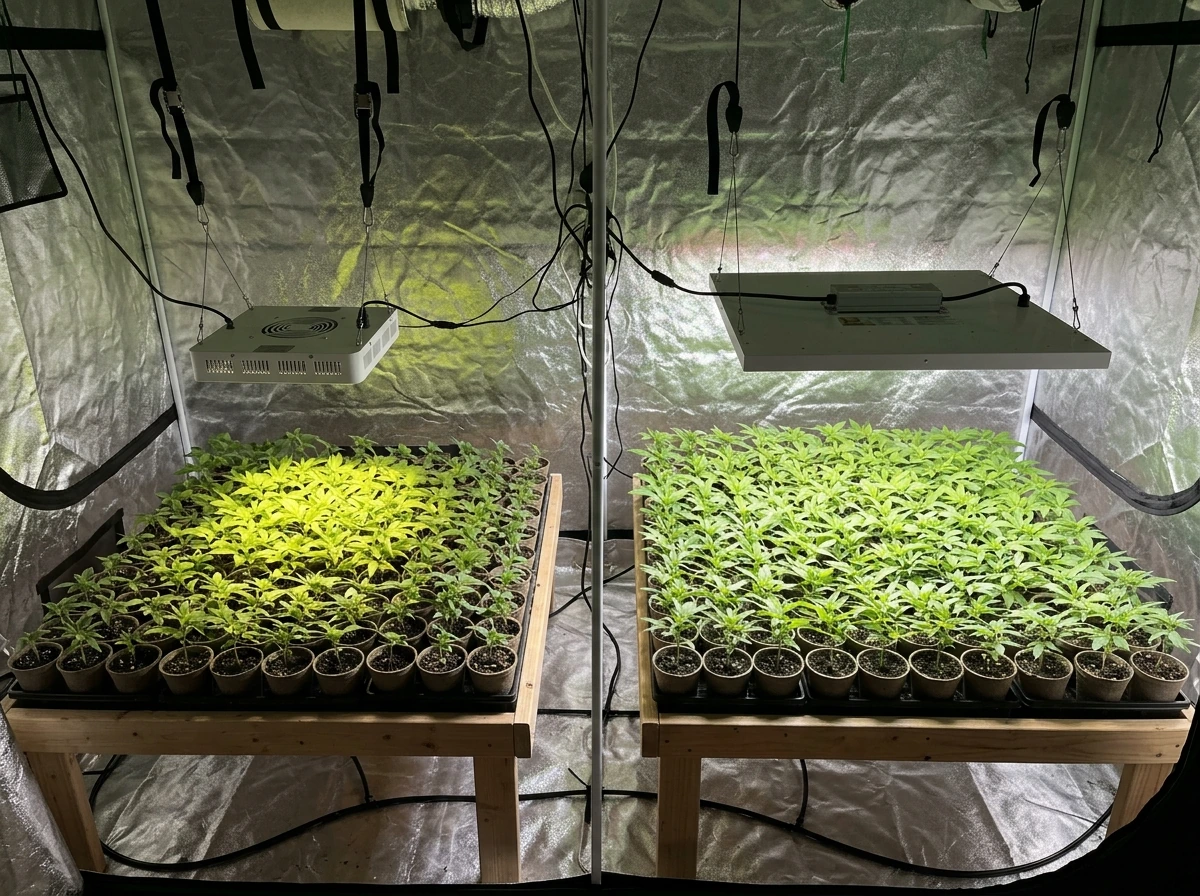
Coverage footprint is where manufacturers do the most creative marketing. A light advertised as covering a 4x4 is often measured at a low intensity threshold that would not sustain fruiting plants. Always look for coverage specs measured at a PPFD (photosynthetic photon flux density) of at least 400 to 600 µmol/m²/s for vegetative crops and 600 to 900+ for flowering or fruiting plants. Here is how I think about fixture sizing by tent area:
| Tent Size | Recommended True Wattage Draw | Target PPFD Range | Typical Use Case |
|---|---|---|---|
| 2x2 (4 sq ft) | 100 to 150W | 400 to 600 µmol/m²/s | Seedlings, herbs, clones, microgreens |
| 2x4 (8 sq ft) | 200 to 250W | 400 to 700 µmol/m²/s | Herbs, leafy greens, low-demand flowering |
| 3x3 (9 sq ft) | 250 to 300W | 500 to 800 µmol/m²/s | Veg to early flower, mixed crops |
| 4x4 (16 sq ft) | 400 to 480W | 600 to 900 µmol/m²/s | Fruiting plants, full cycle flowering |
| 5x5 (25 sq ft) | 600 to 700W | 700 to 1000 µmol/m²/s | High-demand crops, commercial hobby |
| 4x8 (32 sq ft) | 800 to 1000W | 700 to 1000+ µmol/m²/s | Multi-plant fruiting, semi-commercial |
For a 4x4 tent specifically, which is the most common home grow setup, a fixture drawing around 400 to 480 true watts from the wall with an efficiency of at least 2.5 µmol/J is the sweet spot right now. That gets you into the 800 to 1000 µmol/m²/s range at the canopy, which is enough to push fruiting plants hard without burning them. Lights in this category from bar-style or quantum board designs consistently hit those numbers and have become the dominant form factor at this size.
For smaller spaces like a 2x2 or 2x4, do not just buy a lower-watt version of a big panel and assume you are done. Uniformity matters more at small scale. A single point-source panel in a 2x2 can create hotspots in the center and dark corners at the edges. Bar-style fixtures or multi-chip designs with broader distribution handle small tents better and give you more even coverage across the whole canopy.
Full-Spectrum vs. Specialized LEDs: What Spectrum Do You Actually Need
Full-spectrum LEDs are the right choice for the vast majority of growers, and I say that without hesitation. Full-spectrum fixtures typically cover the 380 to 780 nm range with a spectral output that approximates sunlight, including meaningful blue (400 to 500 nm), green (500 to 600 nm), and red (600 to 700 nm) energy. PAR, as defined for plant photosynthesis measurement purposes, covers 400 to 700 nm, and full-spectrum quantum sensors measure across that entire band. Modern white-LED quantum boards and bar fixtures deliver this coverage efficiently and support plants through every growth stage without requiring you to swap lights between veg and flower.
Specialized LEDs, meaning blurple fixtures (heavy red and blue, little green), dedicated far-red supplemental bars, or UV-boosted lights, are not for beginners and usually not necessary for most home growers. The blurple style has largely been proven inferior in real-world grow tests when compared head-to-head with white-LED full-spectrum designs at equivalent output. Where specialized spectrum does add value is in fine-tuned commercial applications: far-red supplemental lighting (700 to 800 nm) can accelerate flowering and improve yield in some crops, and UV (280 to 400 nm) can enhance secondary metabolite production in specific plants. But these are incremental gains for growers who have already dialed in everything else.
| Spectrum Type | Best For | Avoid If | Efficiency Trade-off |
|---|---|---|---|
| Full-spectrum white LED | All growth stages, all common crops, beginners to advanced | You have very specific far-red or UV requirements | Excellent (2.3 to 3.0+ µmol/J on top models) |
| Blurple (R+B heavy) | Virtually no modern use case | You want real yield and plant health | Poor to moderate; dated technology |
| Far-red supplemental bar | Triggering faster flowering finish in specific crops | You are still dialing in your base spectrum | Adds DLI at 700 to 800 nm, not counted in PAR |
| UV supplemental | Boosting terpenes, flavonoids in advanced grows | You are a beginner or running leafy greens | Typically low output, targeted use only |
| Dual-channel (veg/bloom) | Growers wanting flexible spectrum control | You want the simplest possible setup | Moderate; dimming channels add versatility |
The bottom line on spectrum: buy a quality full-spectrum white LED and you will not leave meaningful performance on the table for any common grow scenario. If you are running fruiting plants and want to experiment with far-red at the end of flower, that is a separate, inexpensive supplemental bar you can add later. Do not let spectrum complexity paralyze your initial purchase.
What Plants Actually Thrive Under LED Grow Lights
Almost every plant grown indoors does well under a quality full-spectrum LED, but some are far better suited to LED setups than others because of their light intensity requirements and growth habits.
Easy wins for LED setups
- Leafy greens (lettuce, spinach, arugula, kale): low light intensity needs, fast cycles, extremely forgiving under LED at 200 to 400 µmol/m²/s
- Herbs (basil, cilantro, parsley, mint, chives): moderate light needs, thrive at 300 to 500 µmol/m²/s, ideal for smaller 2x2 to 2x4 setups
- Microgreens and sprouts: minimal intensity needed, excellent for low-watt LED panels or even LED grow bulbs in small trays
- Succulents and cacti: tolerate lower DLI, good for accent or supplemental LED setups
More demanding plants that LED handles well
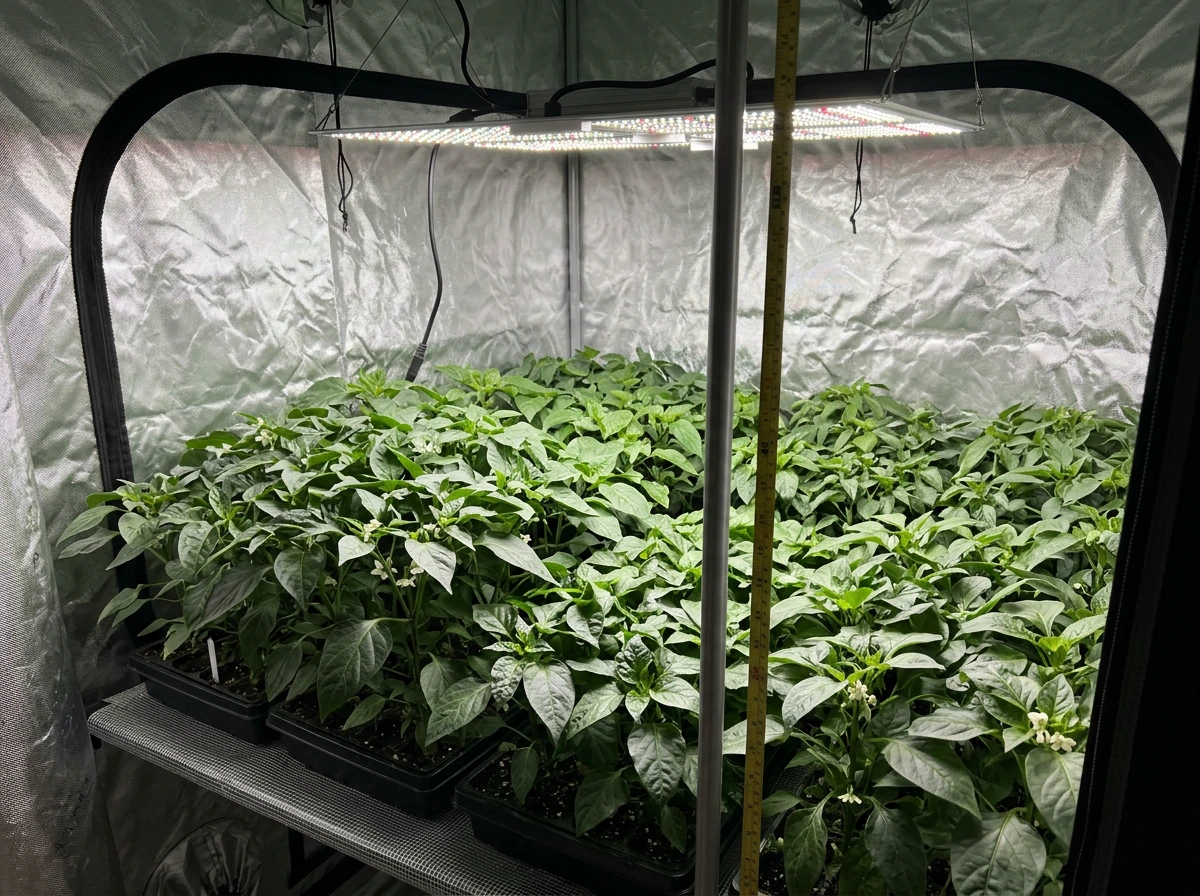
- Tomatoes and peppers: high light demand (30 to 45 mol/m²/day DLI), need 600 to 1000+ µmol/m²/s at the canopy, require quality 400W+ fixtures for a 4x4
- Cucumbers and squash: aggressive growers that respond well to high-intensity full-spectrum LED, important to manage canopy height
- Strawberries: moderate to high light, full-spectrum LED produces good fruit set when intensity and photoperiod are dialed in
- Flowering houseplants (orchids, African violets): respond well to the blue-heavy side of full-spectrum LED, need careful distance management
- Seedlings and clones: benefit enormously from LED due to lower heat output compared to HID, reduce damping-off and stress during propagation
Where LED historically struggled (large-canopy, single-point light penetration for dense fruiting crops) has largely been solved by bar-style fixture designs that spread photons across the canopy more uniformly. If you are growing tall fruiting plants, choose a bar array or a fixture with multiple emitter bars rather than a single flat panel, and adjust mounting height accordingly to avoid intensity drop-off at canopy edges.
Wattage, Efficiency, and the Real Performance Specs That Actually Matter
This is the section I wish every grow light buyer read before making a purchase. Wattage tells you how much power a fixture consumes. It tells you almost nothing about how many usable photons land on your plants. The specs that actually matter are PPF, PPFD, efficiency (µmol/J), and coverage uniformity.
PPF (Photosynthetic Photon Flux)
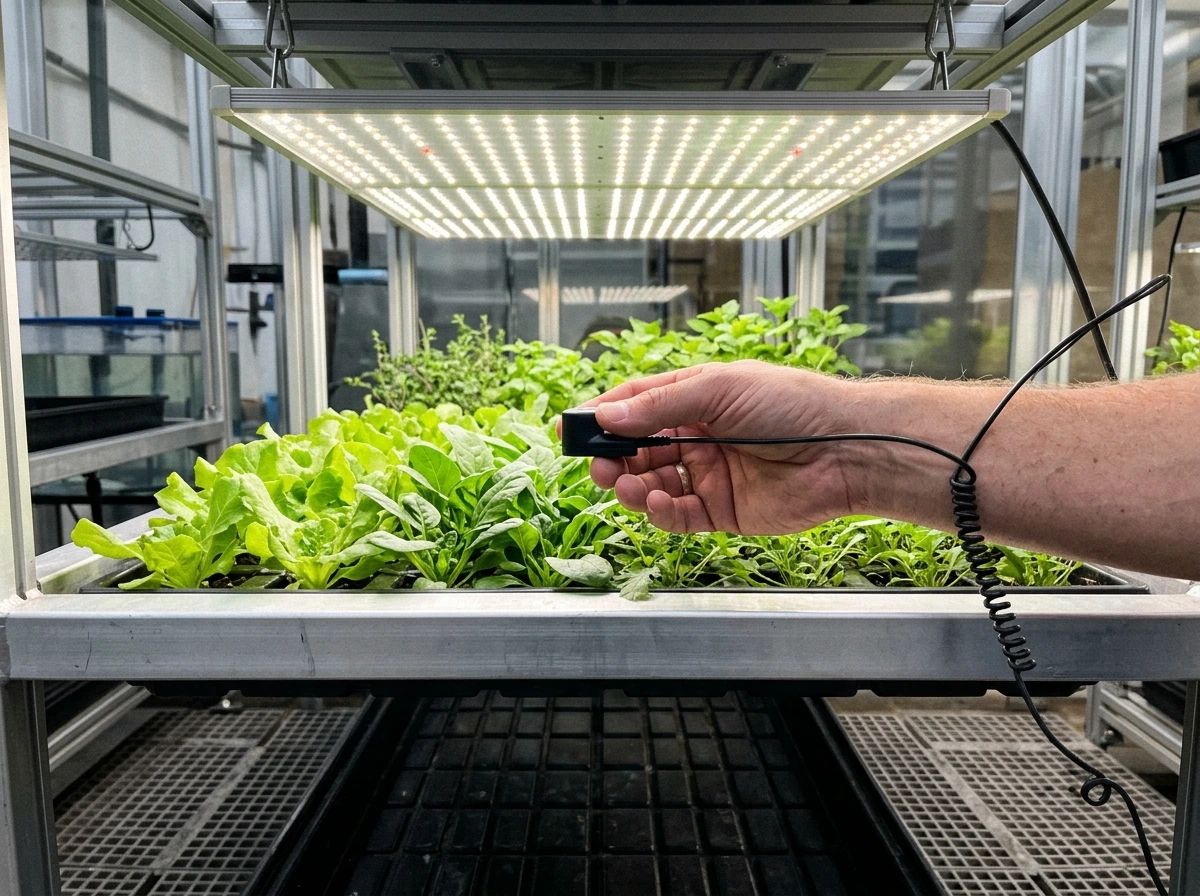
PPF is measured in µmol/s and represents the total number of PAR photons (400 to 700 nm) a fixture emits per second in all directions. The DesignLights Consortium (DLC) horticultural lighting program uses PPF (denoted as Φp) as one of its primary performance variables for evaluating and listing horticultural fixtures. A fixture listed on the DLC Horticultural QPL has been third-party tested and verified for its PPF output, which is a meaningful quality signal. Higher PPF means more photons available for plant use, but it does not tell you how those photons are distributed.
PPFD (Photosynthetic Photon Flux Density)
PPFD is PPF divided by coverage area, measured in µmol/m²/s, and it is what plants actually experience at canopy level. This is the number you compare against your target DLI. A manufacturer showing you a single-point PPFD measurement directly under the fixture is not giving you useful information. What you want is a PPFD map showing readings at multiple points across your grow area, ideally in a grid pattern. If a brand is not publishing a PPFD map, that should make you skeptical.
Efficiency (µmol/J)
Efficiency, expressed in µmol of PAR photons per joule of energy consumed, is the single best number for comparing fixtures on a value basis. Budget fixtures from a few years ago hovered around 1.5 to 2.0 µmol/J. Mid-range fixtures today consistently hit 2.3 to 2.7 µmol/J. Top-tier commercial-grade bars from Samsung LM301H or LM301B-based designs with quality drivers are reaching 2.8 to 3.1 µmol/J. The DLC also tracks photosynthetic photon intensity distribution (PPID), which describes how photons are distributed spatially, a useful metric for evaluating uniformity across a canopy.
What good specs actually look like
| Spec | Budget Fixture | Mid-Range Fixture | Premium Fixture |
|---|---|---|---|
| Efficiency (µmol/J) | 1.5 to 2.0 | 2.3 to 2.6 | 2.7 to 3.1+ |
| PPF per fixture | Lower, often unverified | Typically third-party tested | DLC-listed, verified |
| PPFD map provided | Rarely, or single-point only | Usually available | Full grid map standard |
| Dimming control | Fixed or basic switch | 0 to 100% dial or RJ14 | Programmable, daisy-chain |
| Driver quality | Unknown or no-name | Meanwell or equivalent | Meanwell HLG, Inventronics |
| Spectrum | Variable, often blurple legacy | Full-spectrum white LED | Full-spectrum, tunable options |
| Warranty | 1 year or less | 2 to 3 years | 3 to 5 years |
One more thing to watch for: claimed wattage vs. true wall draw. A fixture marketed as a 1000W LED that draws 400W from the wall is a 400W fixture. That is not inherently a problem, as modern LEDs produce more usable light per watt than older HID systems, but you need to know the true power draw to calculate your electricity costs and compare apples to apples across products.
Form Factors and Installation: Bars, Panels, Bulbs, and Mounting Height
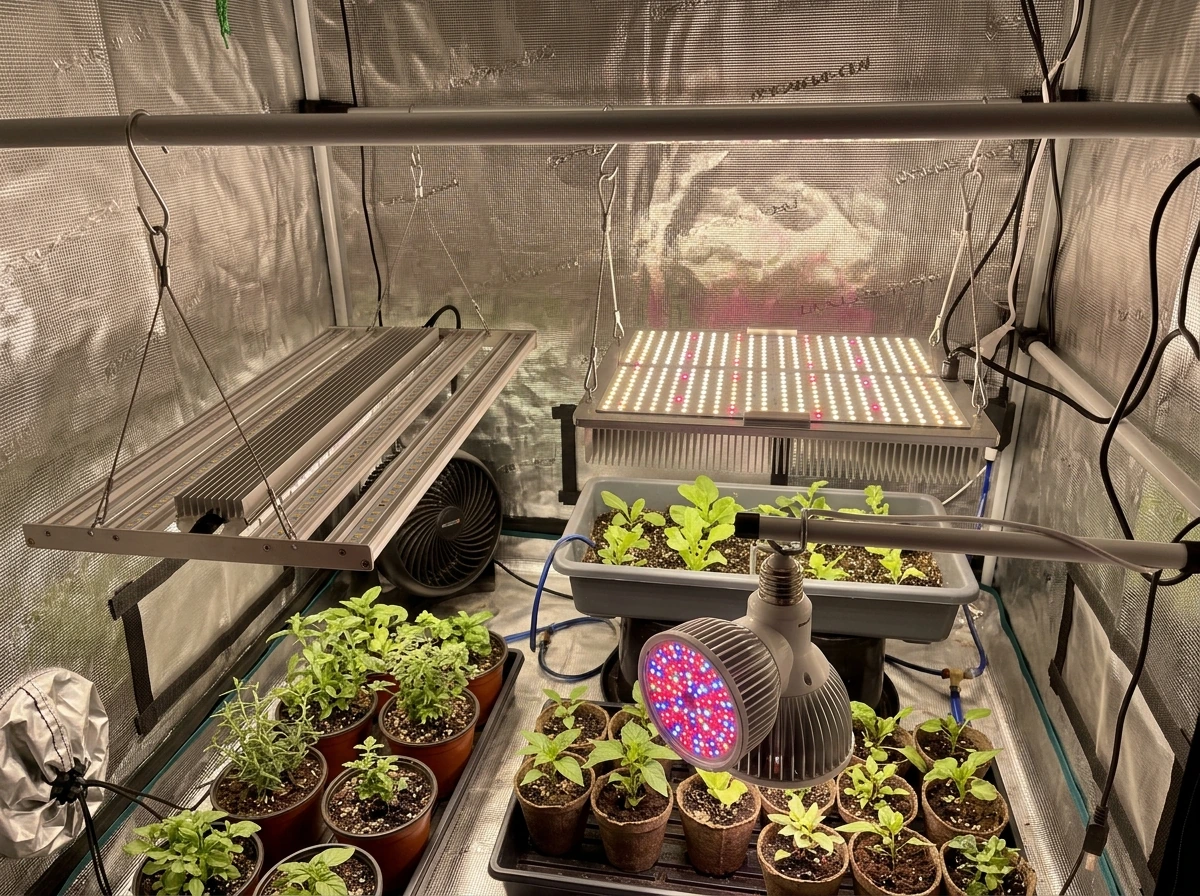
Quantum board panels
Flat quantum board panels were the dominant LED grow light design from roughly 2018 to 2022 and are still a solid choice for 2x2 to 4x4 applications. They use a large PCB studded with high-efficiency white LEDs (typically Samsung LM301 series or equivalent), which spreads light across a wide angle and reduces hotspots compared to older COB-style fixtures. Panels are generally lower-profile and easier to mount in tents with limited vertical clearance. The main limitation is uniformity at canopy edges in larger spaces, which is why bar-style designs have taken over at 4x4 and above.
Bar-style fixtures
Bar arrays, where multiple narrow LED bars are spread across a frame, have become the preferred form factor for serious growers in 4x4 spaces and larger. The distributed emitter placement dramatically improves canopy uniformity compared to a single-panel design. Most commercial greenhouse LED installations use bar or strip configurations for exactly this reason. Bar-style fixtures also tend to run cooler per bar since heat is distributed across more surface area. For home tent growers at 4x4 or 5x5, a good bar fixture is almost always worth the slight price premium over a comparable panel.
LED grow light bulbs
LED grow bulbs (screw-base or plug-in designs meant for standard fixtures or clamp lights) occupy a very specific niche: small-scale, low-budget, or supplemental applications. They are genuinely useful for starting seedlings, boosting light for a single houseplant, or supplementing a windowsill setup. What they cannot do is replace a proper grow light panel or bar for a 2x2 or larger space. The output is simply too low and the coverage too narrow. If you are looking at a grow bulb, understand that you are buying a tool for a very specific, limited job. For more detail on evaluating these, the best led grow bulb guide elsewhere on this site covers that category in depth.
Mounting height guidelines
Mounting height directly controls PPFD at the canopy, and getting it right is just as important as buying the right fixture. Most manufacturers publish recommended hanging heights, but here is a practical starting framework:
| Growth Stage | Typical PPFD Target | Approximate Mounting Height (varies by fixture) |
|---|---|---|
| Seedlings / Clones | 100 to 300 µmol/m²/s | 24 to 36 inches above canopy |
| Vegetative | 300 to 600 µmol/m²/s | 18 to 24 inches above canopy |
| Flowering / Fruiting | 600 to 900+ µmol/m²/s | 12 to 18 inches above canopy |
| High-intensity finishing | 900 to 1200 µmol/m²/s | 10 to 14 inches (with CO2 supplementation) |
Always use a PAR meter or a PPFD app reading (with appropriate caveats about smartphone sensor accuracy) to verify actual canopy intensity at your setup's specific mounting height. Do not assume the manufacturer's map translates exactly to your tent, because reflective walls and ambient conditions will shift the numbers.
Budget vs. Premium Picks: Where to Spend and Where to Save
The gap between budget and premium LED grow lights has narrowed significantly since 2022. Many mid-range fixtures now use the same Samsung LM301H diodes and Meanwell drivers as premium brands but skip the app integration, programmable timers, and heavy branding markup. If you are a home grower running a 4x4 tent with standard photoperiods and no need for automated dimming schedules, you genuinely do not need to spend at the top of the market.
Where budget options are genuinely competitive
- Seedling and clone stages where intensity requirements are low
- Leafy green and herb production where DLI targets are modest
- Growers running manual dimming with a simple dial controller
- Secondary or supplemental lights filling coverage gaps in a larger setup
- First-time growers who want to learn before committing to premium gear
Where premium fixtures justify the cost
- High-intensity fruiting crops where efficiency directly reduces monthly electricity bills
- Growers running multiple lights who benefit from daisy-chain dimming and programmable controllers
- Long-term setups where a 5-year warranty and reliable driver mean lower replacement costs
- Commercial or semi-commercial scale where DLC listing matters for rebate eligibility
- Anyone who wants verified, third-party-tested PPF data and a real PPFD uniformity map
A realistic budget for a solid mid-range 4x4 fixture in 2026 is $200 to $350. Premium bar-style fixtures with full DLC listing and programmable control run $400 to $700 for the same footprint. The premium pays off in electricity savings over 18 to 24 months for growers running 18-hour photoperiods on fruiting crops. For herbs and greens on a 12-hour cycle, the payback period extends considerably and the mid-range option often makes more financial sense.
Your Buying Checklist Before You Click Purchase
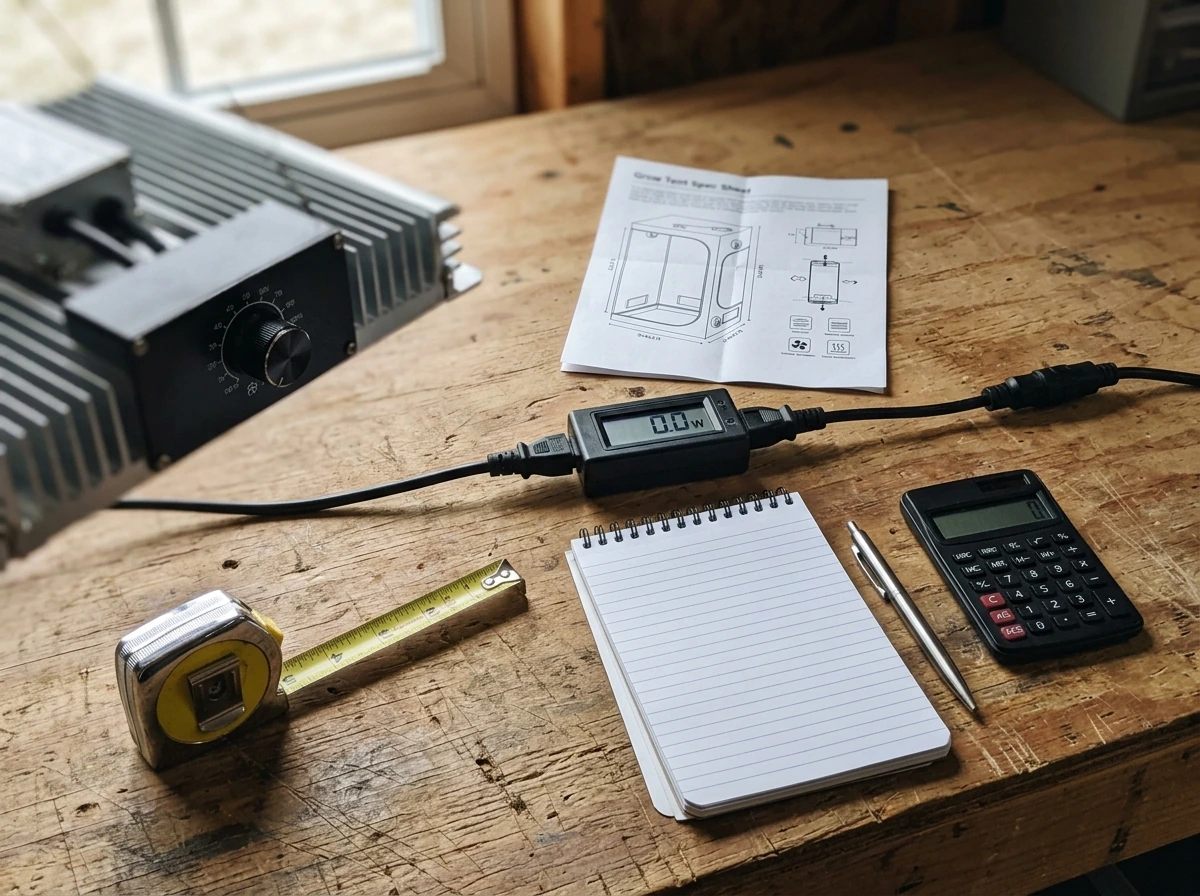
Run through this list before committing to any fixture. It takes five minutes and saves real money.
- Confirm the true wall draw in watts (not the marketing wattage) and calculate your estimated monthly electricity cost at your local rate
- Check the efficiency rating in µmol/J: aim for at least 2.3 for mid-range and 2.7+ for premium
- Find the PPFD map for your specific tent size at your intended mounting height, not just a peak center reading
- Verify the driver brand: Meanwell or equivalent is a minimum bar for reliability
- Check whether the fixture has a DLC Horticultural QPL listing for verified PPF data
- Confirm dimming capability: at minimum a 0 to 100% dial, ideally RJ14 daisy-chain or app control for multiple fixtures
- Match the form factor to your tent: bar arrays for 4x4 and larger, panels acceptable for 3x3 and below
- Check the warranty length and whether the company has a real support channel
- If buying a grow bulb, confirm your actual use case is single-plant supplemental or seedling tray, not a full tent replacement
- Read reviews that mention heat output and long-term reliability at 12 to 18 months of use, not just initial impressions
One final note: where you buy matters almost as much as what you buy. Purchasing from a retailer with a real return policy gives you a meaningful trial window to verify actual performance in your specific space. For a deeper look at reputable retailers and what to watch for when buying online, the where to buy led grow lights guide on this site covers that ground specifically. If you are cross-shopping Amazon listings specifically, the best led grow lights amazon article breaks down how to evaluate listings where spec sheets are often incomplete or misleading.
Get your tent size dialed in, match it to an efficient full-spectrum fixture with a real PPFD map, verify the driver and warranty, and you will have 90% of the decision made. The rest is fine-tuning for your specific crop and budget. That is genuinely all there is to it once you stop buying watts and start buying photons.
FAQ
What’s the most common mistake when buying the best LED plant grow light for a tent?
Basing the purchase on box wattage or the marketing “covers 4x4” claim instead of the canopy PPFD and its uniformity. Even two lights with the same coverage area can deliver very different photon levels at the edges, so prioritize PPFD maps (or measured grid readings) over footprint marketing.
How do I calculate the right DLI if the light provides PPFD and I know my photoperiod?
Use DLI as a function of average PPFD and hours on (DLI rises with longer photoperiod and higher PPFD). Start by targeting your crop’s typical DLI range, then adjust mounting height and dimming to bring your canopy average into range, not just the brightest center point.
If a brand only lists a single PPFD number, should I buy anyway?
Avoid it if possible. A single-point PPFD number under the fixture does not reveal edge performance, so you can end up with burned centers and starved corners. If they will not provide a PPFD map or multi-point readings, treat the light as a higher risk choice, especially for 2x2 and 2x4 tents where uniformity is harder to fake.
Do I need a PAR meter or can I rely on a PPFD app?
You can use an app as a rough check, but treat it as directional only, since phone sensors and camera-based estimates can be inaccurate across different LED spectra and intensities. For final dialing, a real PAR meter or a properly calibrated PPFD measurement is the safest way to confirm what your specific mounting height is producing.
What should I look for regarding “true wall draw” before estimating electricity cost?
Check the spec for input power (actual wattage at the wall), not marketing claims like “1000W” or “equivalent.” Then multiply by your daily runtime and local rate. Also note that dimming or stage-based controls can change wall draw, so use the rated power at the dimming level you plan to run.
Is full-spectrum always the right pick, or can blurple be better?
For most home growers, full-spectrum white LEDs are the more efficient default because they provide usable PAR across the 400 to 700 nm band for all common stages without swapping fixtures. Blurple and highly specialized spectrum options are usually only worth it when you have a specific, measured goal (like targeted far-red during late flowering) and you are willing to fine-tune.
Will increasing fixture wattage always improve results if coverage stays the same?
Not necessarily. If higher wattage comes with poor efficiency or worse distribution, you can raise power consumption without raising usable canopy PPFD where plants need it. The better decision path is higher efficiency (µmol/J) and verified uniform PPFD across the canopy, then only increase intensity if your DLI target requires it.
How do I decide between a bar-style light and a quantum board for my tent?
For 4x4 and larger, bar-style fixtures generally help with canopy uniformity because multiple emitter bars reduce hotspots and edge drop-off. Quantum board panels can be great for 2x2 to 4x4, especially when you can manage mounting height and confirm edge PPFD with a map or measurement.
What mounting height should I use if the manufacturer recommendation doesn’t match my tent?
Use the manufacturer height as a starting point, then verify with your own PPFD reading at canopy level. Tent materials, reflective surfaces, and even airflow can shift outcomes, so plan to re-check after you set the final height and run your actual photoperiod.
Do I need dimming control, or can I run lights at full power?
Dimming is most valuable when your target DLI changes by crop stage, when you want to avoid light burn during early growth, or when your fixture is slightly oversized for your space. If your light is already well-matched to the canopy PPFD you need and you can maintain correct mounting height, you may not strictly need dimming, but it still adds flexibility and can reduce operating cost.
How do I know whether a light’s efficiency number is being used fairly?
Look for efficiency in µmol/J that corresponds to the fixture’s usable output across PAR, not a vague marketing statement. Then compare it at similar measured PPF levels and within the same coverage assumptions. If the light claims high efficiency but provides no PPFD map or multi-point coverage data, treat the value as less reliable.
Should I buy based on DLC listing or brand reputation alone?
A third-party verified listing is a strong quality signal because it confirms PPF output and testing methodology. That said, DLC does not automatically guarantee your canopy uniformity for your exact tent setup, so you still want PPFD map data or your own PPFD verification at your mounting height.
Can a grow bulb replace a panel for seedlings or small houseplants?
Yes for very small, localized use cases, like starting seedlings on a narrow surface or supplementing a windowsill setup. But for a true 2x2 or larger tent canopy, bulbs typically cannot deliver enough PAR across the whole area, and the coverage mismatch usually shows up as uneven growth.
What warranty and driver details matter most in the long run?
Prioritize the warranty length, driver quality (often indicated by brand or model family), and whether the company supports parts replacement. Also check whether the warranty terms include performance issues, not only component failure, since LED output can drift over time even if the unit still powers on.
Next Articles
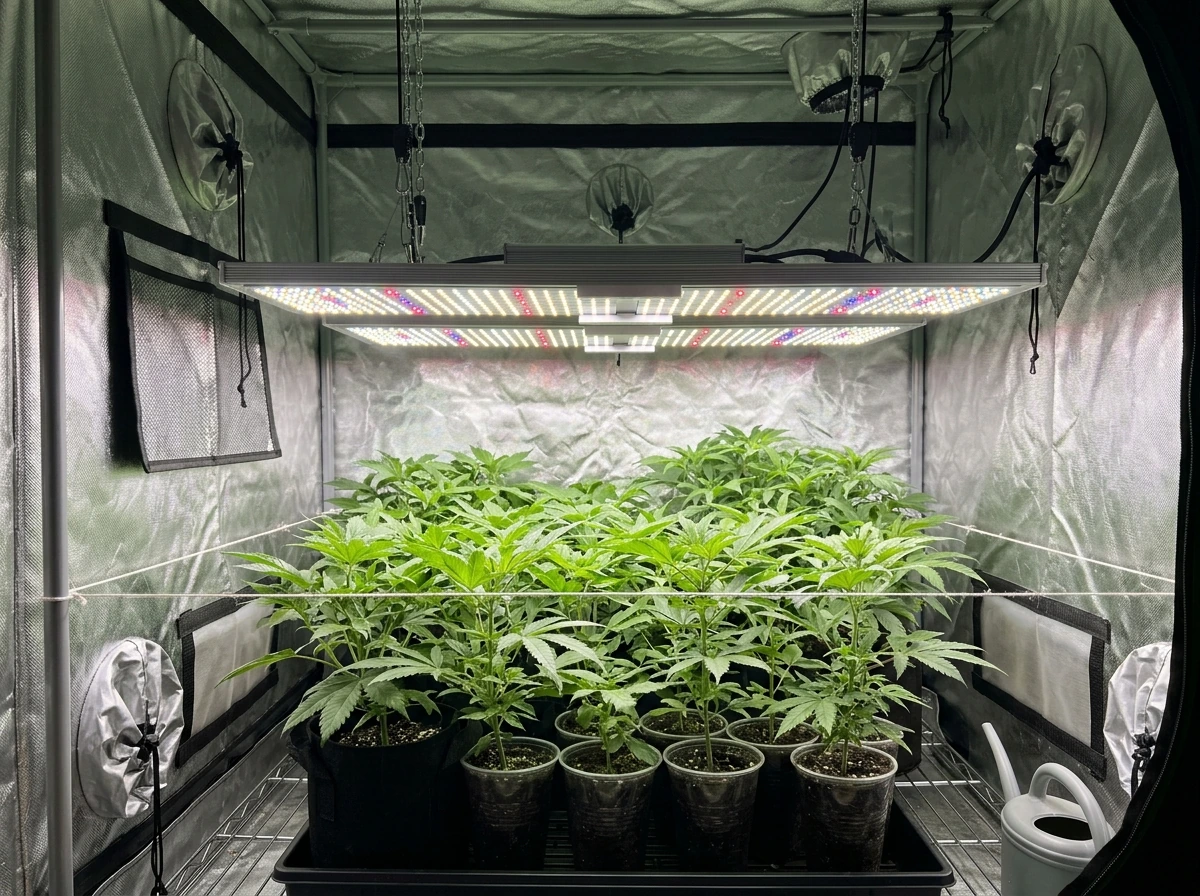
Top LED Grow Lights 2020 Buying Guide for Today
Top LED grow lights 2020 guide: pick the right spectrum, coverage, and wattage for tents or multi-panel setups.
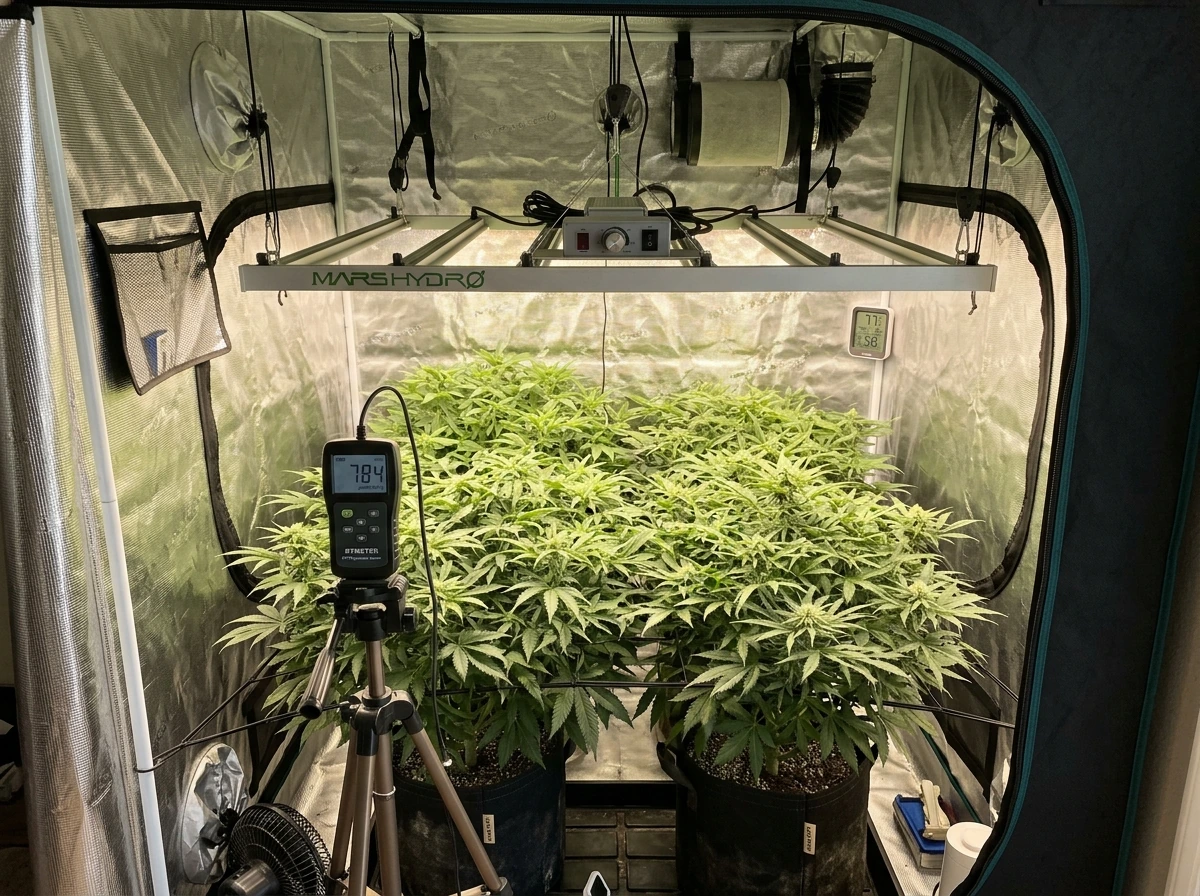
Top LED Grow Lights 2022: Buyer Guide by Space and Stage
Buy top LED grow lights from 2022 using PPFD, coverage, spectrum, efficiency, and setup tips for each grow space size.
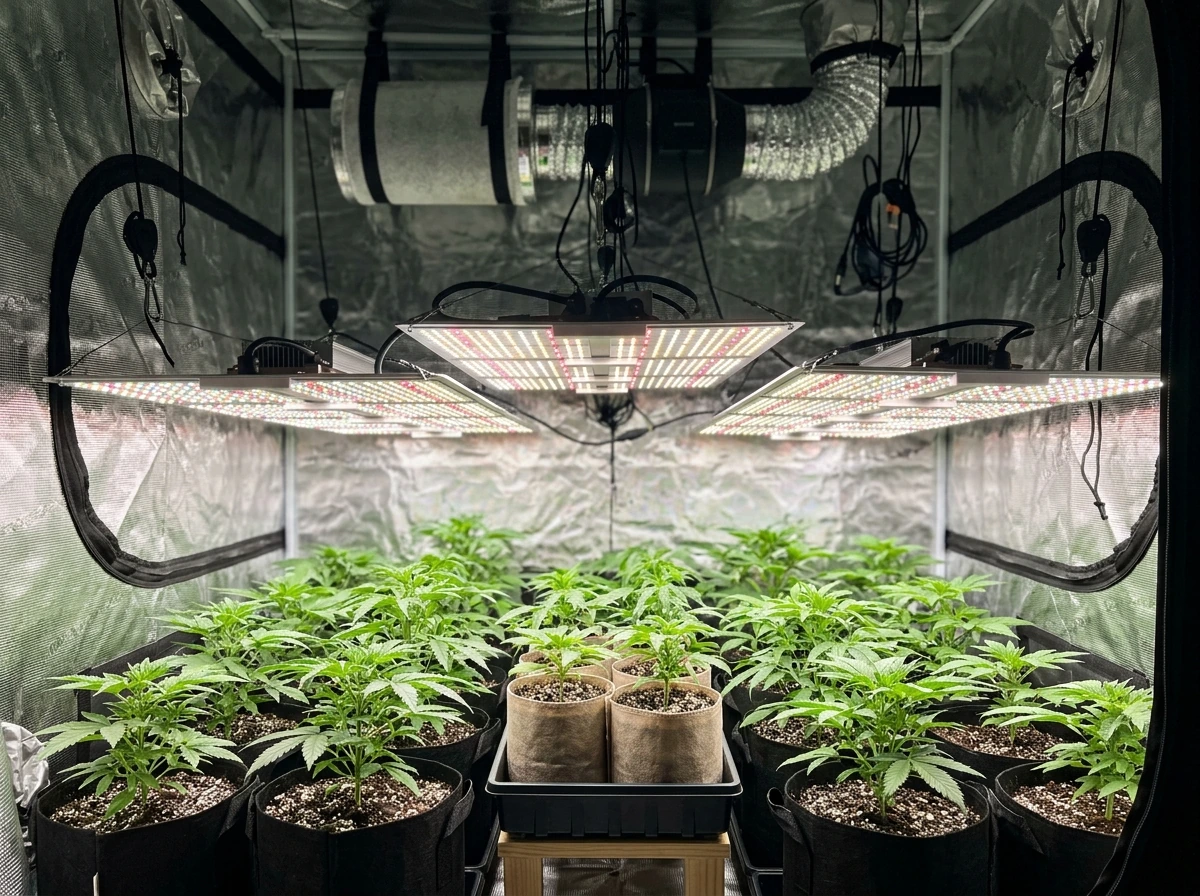
Top LED Grow Lights: How to Choose Best Models for Your Setup
Choose top LED grow lights with PAR, coverage, spectrum, watts, heat, dimming and warranty, plus best model picks by set