The short answer: the best American made led grow lights on Amazon right now are the ones that match your tent size best american made led grow lights with real PPFD numbers, carry a reputable driver (Meanwell or Samsung LM301 diodes are your benchmark), and come from a brand that actually honors its warranty. That rules out about half of what shows up on the first page of results. This guide cuts through the noise and tells you exactly what to buy, what to filter out, and how to shop Amazon's grow light listings without getting burned. where to buy led grow lights
Best LED Grow Lights on Amazon: Buying Guide for Any Setup
Marcus Rutherford
24 Mar 2026
How to Shop for LED Grow Lights on Amazon
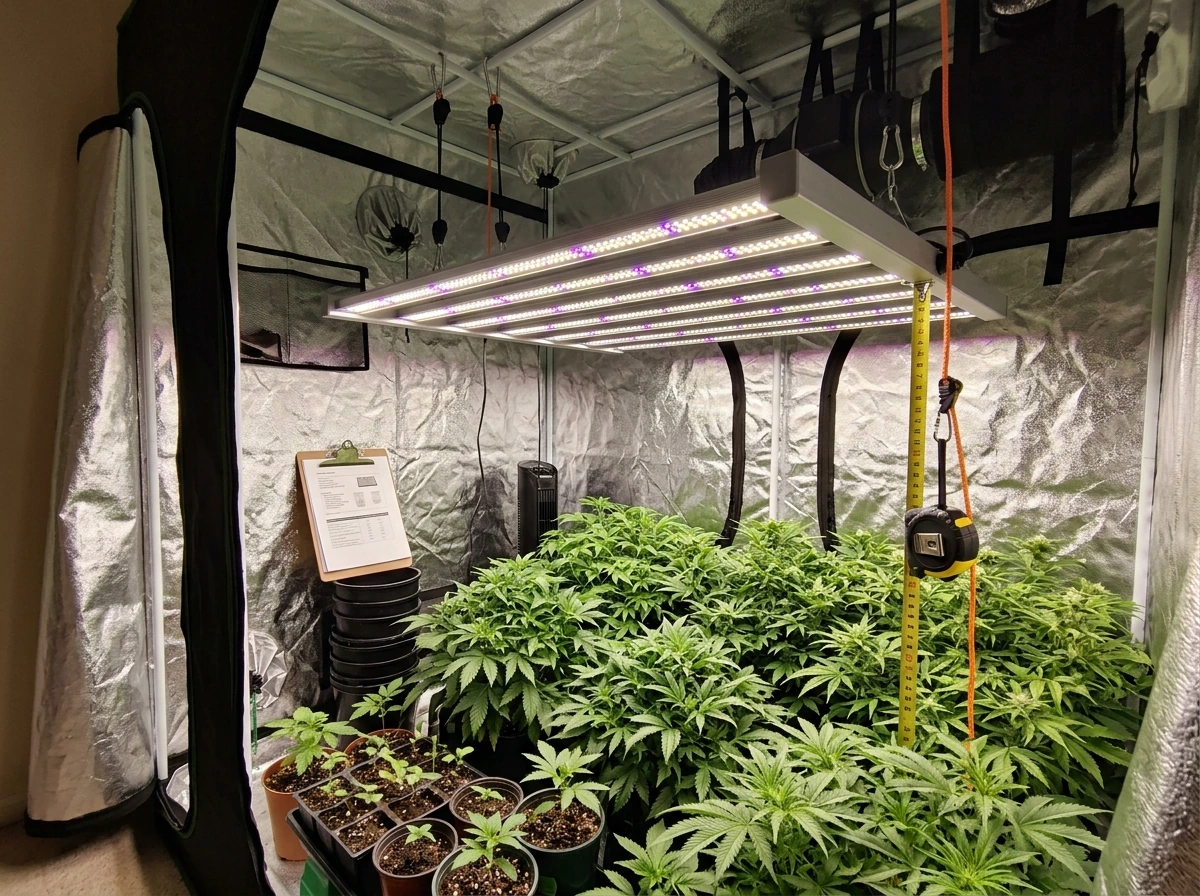
Amazon's grow light category is a mess. You'll find legitimate fixtures from brands like Spider Farmer, Mars Hydro, AC Infinity, and Vivosun sitting alongside dozens of no-name lights with inflated claims and zero accountability. The platform doesn't vet wattage claims or spectrum accuracy, so you need a filtering system before you trust a listing.
Start with these filters and checks before you read a single review:
- Search by actual draw wattage, not 'equivalent' wattage. A light that draws 200W at the wall is a 200W light, period.
- Look for PPFD maps in the listing images or product description. If there's no PPFD data, skip it.
- Check the driver brand. Meanwell is the gold standard. Some brands use their own in-house drivers — that's fine only if they publish efficiency specs.
- Check the diode brand. Samsung LM301B or LM301H diodes are the benchmark for efficiency. Epistar is acceptable at lower price points. 'Bridgelux' can be hit or miss — verify the model number.
- Look for UL 8800 or ETL certification. UL 8800 is a safety standard specifically designed for horticultural lighting equipment, going beyond general luminaire standards like UL 1598. It's also a requirement for DLC horticultural QPL listing.
- Check the DLC Horticultural Qualified Products List (QPL). If a light appears there, it has met third-party testing requirements including PPFD output verification.
- Read 1-star and 3-star reviews, not just the 5-stars. Look for patterns around heat, dead diodes after 6 months, and customer service ghosting.
- Verify the warranty terms in writing inside the listing, not just the badge graphic. Two years minimum; three or more years is ideal.
One more thing: ignore 'coverage area' claims that aren't broken down by grow stage. A light that claims to cover 5x5 feet for flowering at 200W actual draw is lying to you. Vegetative coverage and flowering coverage are different numbers, and any honest listing will show both.
Match the Light to Your Grow Stage
Spectrum and intensity both matter, and they matter differently depending on what stage your plants are in. Getting this right means you're not over-spending on intensity you don't need for seedlings, and you're not under-delivering during the flowering push when plants need maximum photons.
Seedling and Early Veg
Seedlings are sensitive to intense light. You want a full-spectrum white light (3000K–4000K CCT range) at low intensity, roughly 100–300 µmol/m²/s PPFD at canopy level. Almost any decent full-spectrum LED can handle this stage. What matters more here is dimming capability so you can start low and ramp up. A light you can dim to 25–30% of output is far more useful for seedlings than a fixed-output budget panel. Spectrum-wise, a blue-heavy bias (higher 4000K–6500K) slightly favors compact veg growth, but a balanced white spectrum works fine for the full veg stage.
Late Veg and Flowering
Flowering is where your light choice really matters. Plants in bloom want 600–900 µmol/m²/s PPFD at canopy, and photoperiod crops respond well to a spectrum that leans warmer (3000K–3500K) with meaningful red output. Most full-spectrum white LED fixtures designed for flowering already incorporate this bias. What you want to avoid are 'blurple' (red/blue only) lights that dominated Amazon five years ago, they produce misleading PAR readings because their output is concentrated in narrow bands that aren't representative of actual plant-usable light across the full photosynthetic range. Modern quantum board and bar-style fixtures with white COB or white LED arrays outperform them in practice and are easier to evaluate because their PPFD numbers are measured honestly.
Full-Spectrum vs. Supplemental Diodes
Full-spectrum white lights handle seedling through harvest without any changes. Some higher-end fixtures add deep red (660nm), far red (730nm), or UV diodes as supplements to a white base spectrum. Far red can accelerate flowering slightly by triggering the Emerson enhancement effect. UV (280–400nm) may contribute to resin and terpene production. These additions are genuinely useful but are secondary considerations, get the core PPFD and spectrum right first. Don't pay a premium for UV/far-red supplements if the base fixture's efficiency or coverage area is underwhelming.
Power, Coverage, and PPFD: The Numbers You Actually Need
Here's the practical framework for sizing a light to a space. These are real targets based on what plants actually need, not what marketing copy claims.
| Grow Stage | Target PPFD (µmol/m²/s) | Approx. Watts Needed per sq ft | Notes |
|---|---|---|---|
| Seedlings | 100–300 | 10–15W | Dim your light; don't buy a seedling-only fixture |
| Vegetative | 300–600 | 20–30W | Blue-leaning spectrum preferred but not required |
| Flowering | 600–900 | 30–50W | Full-spectrum with red bias; PPFD maps essential |
| High-intensity / CO2 | 900–1200+ | 50W+ | Only worthwhile with CO2 supplementation |
For a 4x4 tent (16 sq ft), you're targeting around 480–800 true watts for serious flowering, but because modern high-efficiency LEDs (2.5–3.0 µmol/J) produce more PAR per watt than older technology, a 480W fixture from a quality brand will hit 700–900 µmol/m²/s in a 4x4, which is plenty. A budget 200W light claiming '1000W equivalent' will not. The efficiency difference is what separates quality fixtures from Amazon junk.
For a 5x5 tent (25 sq ft), plan on 600–800W actual draw for flowering. A 3x3 (9 sq ft) can be handled well by a 200–250W quality fixture. Going smaller than a 3x3, a 2x4 propagation tray, for example, a 100W bar-style or quantum board gets the job done without overkill.
Mounting height affects PPFD significantly. Most quantum board and bar lights are designed to run 18–24 inches above canopy for veg and 12–18 inches for flowering. Lower mounting height increases PPFD but reduces coverage uniformity. Always check a fixture's PPFD map at the mounting height you'll actually use, not just the best-case number the brand puts in the headline.
Form Factor and Mounting: Bars vs. Panels in the Real World
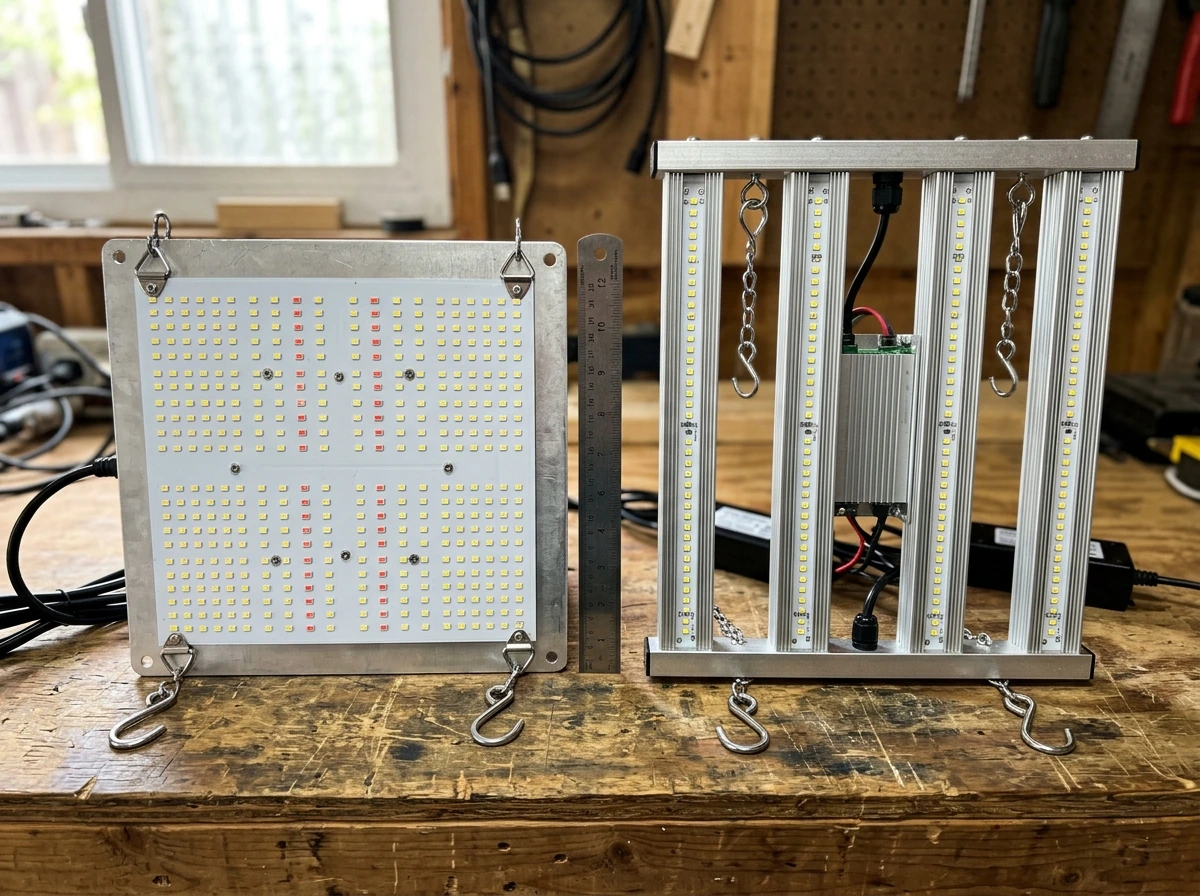
The two dominant form factors on Amazon right now are quantum board panels (a single flat board or folding board design) and bar-style fixtures (multiple LED strips on a frame, sometimes foldable). Each has genuine advantages depending on your setup.
| Feature | Quantum Board Panel | Bar-Style Fixture |
|---|---|---|
| Canopy uniformity | Good in square tents | Excellent — bars spread light more evenly |
| Heat distribution | Concentrated in one unit | Spread across multiple bars, easier to manage |
| Mounting | Single hang point, simple | Usually requires crossbar or daisy-chain rigging |
| Adjustability | Fixed shape | Many fold or adjust bar spacing |
| Best for | 3x3 to 4x4 square tents | 4x4 to 5x5 and rectangular spaces |
| Price point | Generally lower | Slightly higher at same wattage |
| Typical brands on Amazon | Mars Hydro TS, Spider Farmer SF | AC Infinity Ionframe, Mars Hydro FC-E series |
Passive vs. Active Cooling
Passive cooling (heatsink only, no fans) is quieter and has fewer parts to fail. It works well when the fixture's thermal design is solid, Samsung LM301H diodes running at lower drive currents stay cool enough that passive cooling is sufficient. Active cooling (built-in fans) handles higher power densities but adds noise and introduces a component that can fail. In a tent environment where you're already running an inline fan for air exchange, a passively cooled light is almost always the better call if the fixture is well-designed. Watch out for budget panels that use passive cooling on a design that actually runs diodes too hot, that's where you see early diode failure and color shift.
Installation Height and Tent Compatibility
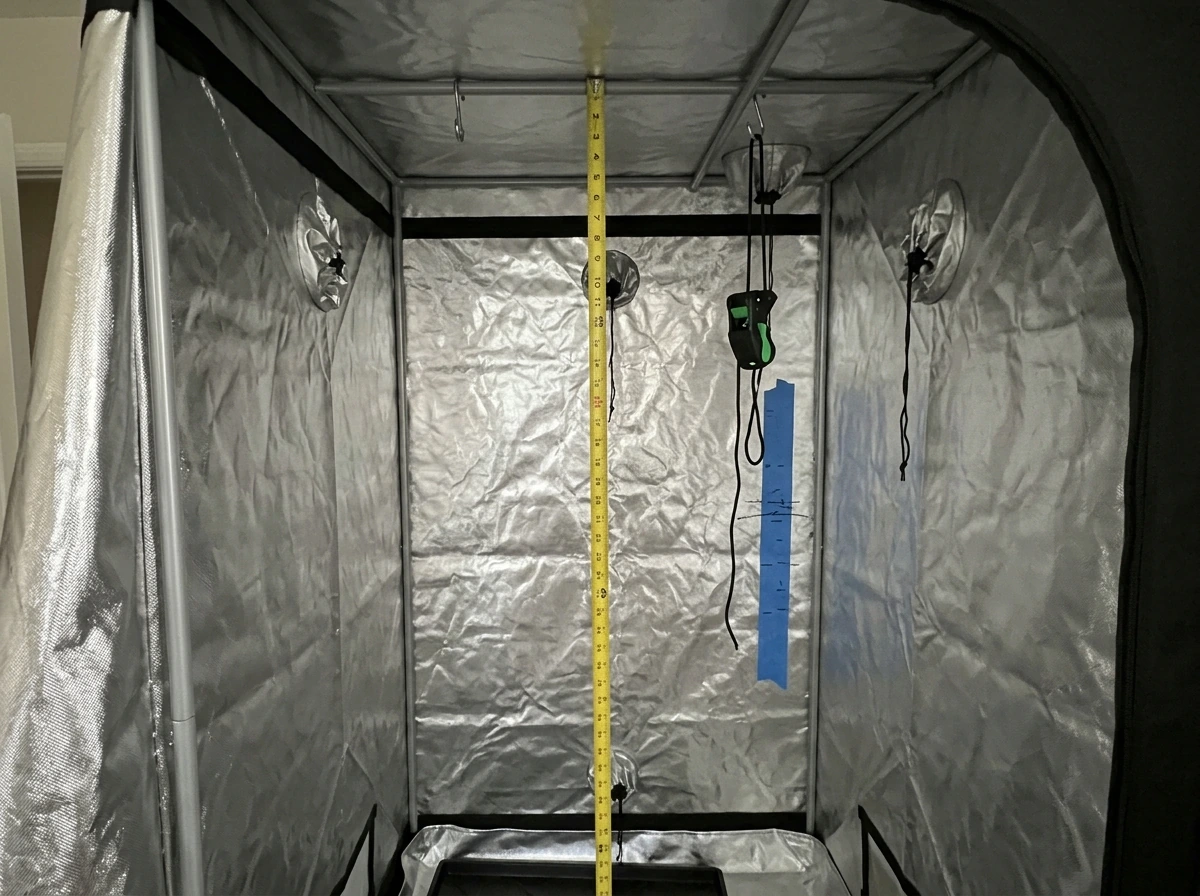
Standard grow tents have interior heights of 60 to 80 inches. Subtract 12–18 inches for canopy height and another 12–18 inches for minimum mounting distance during flowering, and you're working with a 24–56 inch range for the light itself plus its mounting hardware. Bar-style lights with a low-profile frame are easier to fit in shorter tents. Quantum boards are typically thicker when you account for the heatsink. Measure your tent's interior height and compare it against the fixture's hang kit length before purchasing, this is a detail that trips up first-time buyers constantly.
Best Amazon LED Grow Lights by Budget and Tent Size
These recommendations are based on real draw wattage, published PPFD data, driver and diode quality, and what's consistently available on Amazon as of early 2026. Prices shift, so treat the budget tiers as ranges rather than fixed numbers.
Under $150: Small Spaces and Seedling Setups
Mars Hydro TS 1000 (150W actual draw) is the go-to recommendation at this price. It uses Samsung LM301B diodes, produces around 700–800 µmol/m²/s at 18 inches in a 2x2 flowering footprint, and has a three-year warranty that Mars Hydro actually honors. It's a solid 2x2 to 2x4 veg light or a capable 2x2 flowering fixture. The Spider Farmer SF-1000 is a near-identical competitor and worth considering if it's priced similarly, same diode spec, similar output. Both dim to around 10% and are plug-and-play. At this budget, don't go cheaper. The $50–80 lights in this category are almost universally junk.
$150–$350: The 3x3 to 4x4 Sweet Spot
This is where the best value lives on Amazon. The Spider Farmer SF-2000 (200W actual) covers a 3x4 veg footprint and a 3x3 flowering footprint with good uniformity. It uses Samsung LM301B diodes and a Meanwell driver, that combination is the baseline you should expect at this price. PPFD at 18 inches in a 3x3 comes in around 800–900 µmol/m²/s, which is exactly where you want to be for flowering. The Mars Hydro TS 2000 is the main competitor; slightly different thermal design, similar output, and typically a few dollars cheaper. Either works.
For a dedicated 4x4 tent at this budget tier, the Spider Farmer SF-4000 (450W actual) stretches the upper end of this range but is worth it if you're serious about flowering yield. It hits around 850 µmol/m²/s average across a 4x4 at 18 inches. The Mars Hydro FC-E4800 bar-style is a strong alternative with better canopy uniformity in a 4x4 due to its multi-bar design.
$350–$700: Serious 4x4 and 5x5 Flowering Setups
AC Infinity Ionframe Evo 6 (around 320W) and Evo 8 (around 480W) are the standout options in this tier. AC Infinity has built a strong reputation for build quality, and the Ionframe series uses Samsung LM301H diodes (more efficient than LM301B), passive cooling, and integrates with AC Infinity's UIS controller ecosystem for programmable dimming and scheduling. The Evo 8 covers a 4x4 tent for flowering with PPFD averages around 850–950 µmol/m²/s. If you're already running AC Infinity tents and fans, the controller integration alone makes this the easy choice.
Spider Farmer SE5000 (480W) is another strong performer at this tier, with a bar-style design and excellent uniformity across a 4x4 to 5x5 footprint. Mars Hydro FC6500 (650W) pushes into 5x5 territory with genuine output data to back the claim. All three brands publish third-party PPFD reports, ask for them in the Q&A if they're not in the listing.
$700 and Up: Near-Commercial and Multi-Light Setups
At this level, you're typically looking at 600W–1000W single fixtures or planning multi-light configurations. The Mars Hydro FC8000 (800W) is one of the highest-output bar-style fixtures consistently available on Amazon with legitimate published PPFD data for 5x5 to 6x6 coverage. Efficiency at this wattage class from reputable brands runs 2.7–2.9 µmol/J, which is competitive with anything on the market. Vivosun's VS4300i and VS6450i fixtures appear here too, and while Vivosun's build quality has improved significantly, their warranty support still lags behind Spider Farmer and Mars Hydro based on user feedback. For commercial-scale intent, you're likely better off looking beyond Amazon for fixtures with DLC QPL listing and proper photometric reports, something worth exploring if you're moving beyond hobby grows.
What to Expect from Performance, Efficiency, and Warranty
Efficiency is the metric that determines your long-term electricity cost. The best fixtures on Amazon in 2026 run 2.5–3.0 µmol/J (micromoles of PAR per joule of electricity). Budget lights often hit only 1.5–2.0 µmol/J, which means you're paying significantly more in electricity over a grow cycle for the same light output. On a 480W light running 18 hours/day for veg over 8 weeks, the difference between a 2.0 and 2.8 µmol/J fixture is meaningful on your power bill.
Dimming is non-negotiable for a serious setup. Look for 0–100% continuous dimming (or at minimum 25%–100%). Fixtures that only step-dim (e.g., 25%, 50%, 75%, 100%) are less useful for dialing in the right intensity for each grow stage. Some mid-range and premium fixtures include a RJ45 port for daisy-chaining and external controller compatibility, genuinely useful if you're running multiple lights or want automation.
For warranty, the minimum acceptable on Amazon is two years, but three years from a brand with documented customer service is far better. Spider Farmer and Mars Hydro both offer three-year warranties and have established US-based support. AC Infinity backs their fixtures with a two-year warranty but has consistently strong customer service responsiveness. Avoid listings where the warranty language is buried, vague, or says 'contact seller' with no brand contact information.
Build quality tells you a lot at first glance. Look at the heatsink thickness in the product images. A thin, lightweight aluminum extrusion on a 400W fixture is a red flag. Quality fixtures use substantial heatsinks because that's what keeps diodes at safe operating temperatures, which directly determines lifespan. Diodes run hot, degrade faster, and shift color output when thermal management is poor.
Amazon Grow Light Pitfalls to Avoid
This is the section that saves you money. These are the most common ways growers get burned buying LED grow lights on Amazon.
Fake and Inflated Wattage Claims
This is the number-one issue. A listing title says '2000W LED Grow Light' and the actual draw at the wall is 200–300W. The '2000W' figure is a fictional 'HPS equivalent' or 'maximum theoretical' number that means nothing. Always find the 'true power' or 'actual power draw' spec in the listing details, usually buried in the technical specifications table. If it's not there, ask in the Q&A. If the seller doesn't answer clearly, walk away.
Poor Drivers and Electrical Safety
Cheap drivers are a fire hazard, not just a performance concern. No-name drivers in budget lights can overheat, fail, or operate outside safe electrical parameters. UL 8800 certification addresses photobiological safety and electrical safety specifically for horticultural lighting, it goes beyond what standard lamp certifications cover. ETL listing is an acceptable alternative. If a fixture has neither, it hasn't been independently tested for safety in a grow environment. Don't hang an uncertified light over a flammable grow tent with running water nearby.
Untrustworthy Spectrum Claims
Vague spectrum language like 'full-spectrum sunlight simulation' or 'optimized plant spectrum' without a spectral distribution chart or CCT specification is a red flag. A credible listing will show you the spectral power distribution graph, the actual wavelength output of the fixture. If the light is mostly red and blue peaks with a gap in the green range, it's a blurple design dressed up in full-spectrum marketing language. Look for a broad white-light spectrum with supplemental peaks, not narrow-band dominant designs.
Heat and Cooling Failures
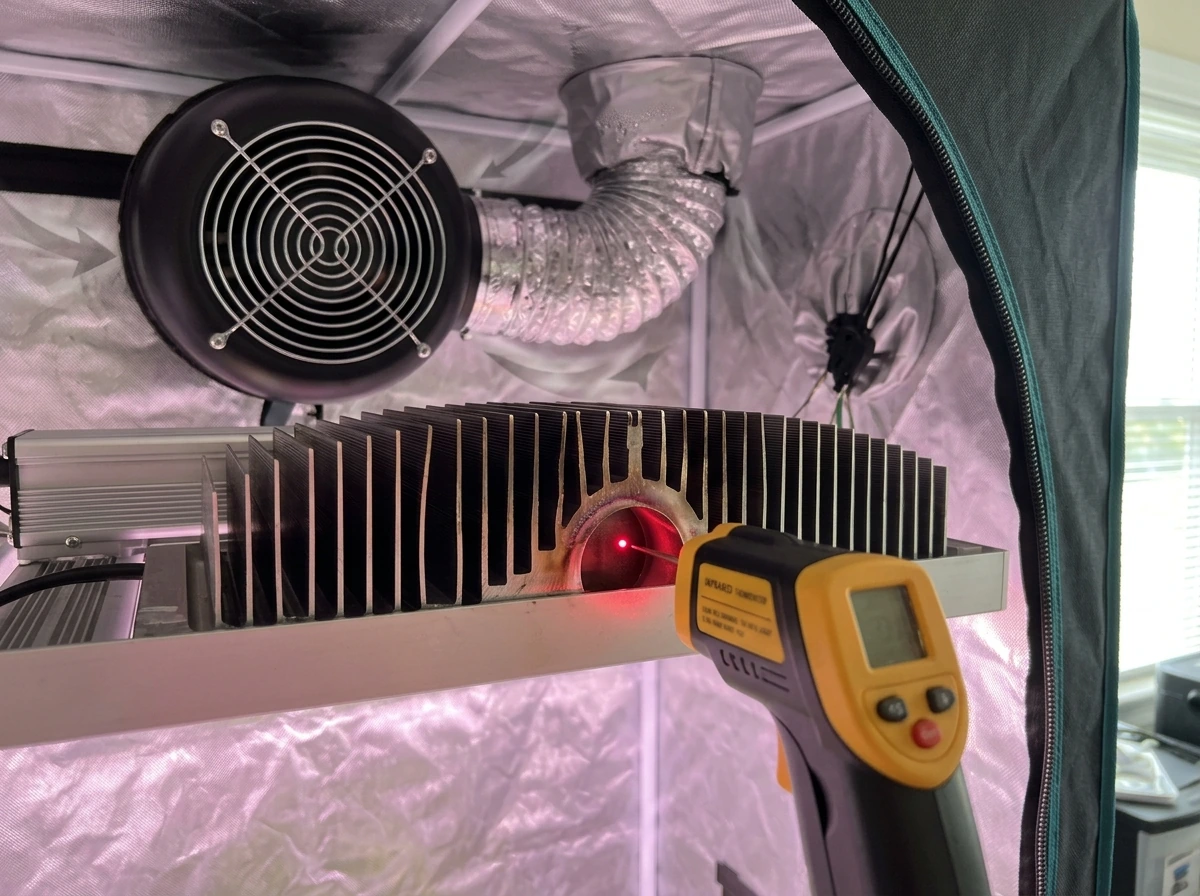
Budget lights often run diodes at maximum rated current to hit their wattage claims, which means the heatsink is always fighting to keep up. In a warm tent environment (75–85°F ambient), an undersized heatsink means diodes run at 85°C or higher, temperatures that accelerate lumen depreciation and color shift. A quality fixture running the same diodes at lower drive current with a proper heatsink will last 50,000+ hours. A budget fixture pushing diodes hard with inadequate cooling might start degrading noticeably in 12–18 months.
No Third-Party PPFD Verification
Any brand can print a PPFD map. What you want is third-party tested PPFD data, or at minimum, data that's consistent with the fixture's actual wattage and published diode efficiency. A 200W light claiming 1200 µmol/m²/s average across a 4x4 is physically impossible given current LED technology. Use the DLC's QPL as a shortcut, fixtures listed there have had output verified through independent testing that follows ANSI/IES reporting standards. It's a quick filter that eliminates a lot of guesswork.
Seller Churn and Counterfeit Products
Amazon's marketplace allows third-party sellers to list products under established brand listings, which means you can order what looks like a Spider Farmer SF-2000 and receive a counterfeit. Buy directly from the brand's official Amazon storefront (look for 'Ships from and sold by [Brand Name]' or the verified brand store badge). If you're buying from a third-party seller, check that seller's own reviews and return policy independently.
Your Next Step After Reading This
Pick your tent size, decide your budget tier, and match them using the coverage and wattage framework above. For most hobby growers in a 4x4 tent with a $250–$450 budget, the Spider Farmer SF-4000 or Mars Hydro FC-E4800 are the clearest buys right now. For smaller spaces or tighter budgets, the TS 1000 or SF-2000 are the honest workhorses. If you're scaling up toward a 5x5 or running multiple tents, the AC Infinity Ionframe Evo 8 or Mars Hydro FC6500 give you room to grow without replacing equipment.
Before you hit buy, run through the checklist: actual draw wattage confirmed, PPFD map present, driver brand identified, UL 8800 or ETL certified, warranty terms in writing, sold by the official brand storefront. If a listing passes all six checks, you're in good shape. If it fails any of them, there's a better option one scroll away.
FAQ
What do I do if Amazon won’t show the fixture’s PPFD map at my mounting height?
Ask in the Q&A for PPFD readings at the exact hang height you plan to use (for example, 18 inches for flowering). If the seller only provides a single “headline” number, request whether it was measured with the same draw wattage and at canopy. If they cannot confirm both, treat the PPFD as unverified and downgrade your expected coverage or move to a different brand that publishes consistent maps.
Can I safely use the same LED for seedlings and flowering without changing anything?
Yes in most cases if it is a full-spectrum white fixture with dimming. The practical catch is intensity control, for seedlings you should run low output and ramp gradually, rather than keeping the same PPFD as flowering. If a light only has fixed steps instead of smooth dimming, plan to limit how aggressively you ramp, because seedlings can be stressed by sudden intensity jumps.
How close can I mount a quantum board or bar-style light without bleaching leaves?
Use the fixture’s stated mounting minimum, then validate with your measured or expected PPFD. In a warm tent (especially above 80°F), the “safe distance” can be effectively shorter or longer depending on thermal headroom and dimming range. A safer approach is to start higher than the minimum, run a lower dim level for a week, then lower gradually while watching for leaf tip curl and bleached spots.
Is “DLC QPL” required, or is third-party PPFD testing enough?
It is not required for hobby use, but it is a strong shortcut when you are unsure whether claims are marketing. If a fixture has no DLC listing, look for third-party PPFD testing that matches the same draw wattage, and confirm that the report is for the actual model and not a prototype. DLC QPL helps because output verification follows standardized reporting practices.
How do I calculate my real electricity cost difference between a 2.0 and 2.8 µmol/J light?
Use run wattage and your schedule, for example 480W for 18 hours/day. Then compare the cost per kilowatt-hour with your local electric rate, the efficiency changes output for the same photons, or the photons for the same electricity, depending on your setup. If you already sized by target PPFD, efficiency mostly shows up as lower draw for the same canopy light level, not as an instant “bill surprise.”
What’s the safest way to verify “actual draw wattage” when a listing is vague?
Look specifically for a “power consumption” or “input power” spec in the technical table, not the “equivalent” or marketing wattage. If it is missing, ask for a copy of the driver label or the measured input at rated conditions. If you still cannot confirm actual draw, avoid it, because wattage uncertainty often correlates with inflated coverage claims and questionable driver quality.
Are passively cooled lights always better for tents with fans running?
Not always. Passive cooling is typically preferred when the heatsink design is substantial and the driver is run within safe thermal limits, but tents can vary widely in ambient temperature and airflow. If your room is hot or your tent airflow is weak, an “active” model may maintain diode temperature better even if it is noisier. The deciding factor is whether the fixture runs cool at your expected ambient, you can check this by monitoring temperature behavior after the first few days.
What does “0 to 100% continuous dimming” change in real use?
It makes your intensity ramp much more controllable, especially when you are dialing in PPFD week by week. Continuous dimming is also useful when you need to correct for plant density, canopy height changes, or uneven training. If the fixture is only step-dim, you may overshoot during transitions, leading to stress even if the final target PPFD is correct.
How can I tell if a “full spectrum” light is actually blurple in disguise?
Check whether the listing provides a spectral power distribution chart and a stated CCT range for the white portion. If the “full spectrum” description lacks CCT or SPD details and the visible diode layout is heavily red/blue without meaningful white emitters, assume blurple behavior. A practical giveaway is when the brand tries to substitute “coverage” marketing for actual PPFD, because narrow-band designs often produce misleading metrics.
What are common warranty pitfalls on Amazon listings?
Be careful with vague terms like “contact seller,” because that can make claims slow or inconsistent. Confirm the warranty duration, what it covers (driver only vs full fixture), and the procedure for warranty service through the actual brand. Also check that the listing is sold by the brand storefront or a reputable distributor, since warranty responsibility can differ when you buy through some third-party channels.
Will daisy-chaining multiple lights work with any fixture that has an RJ45 port?
No, the port type alone does not guarantee compatibility. You should confirm the controller standard and whether the fixtures can communicate with the same ecosystem model, then check the maximum number of lights supported per controller. If you are planning automation, choose a package where the brand documents multi-unit control for that exact configuration.
What should I do if I bought a light and it seems dim compared to the claims?
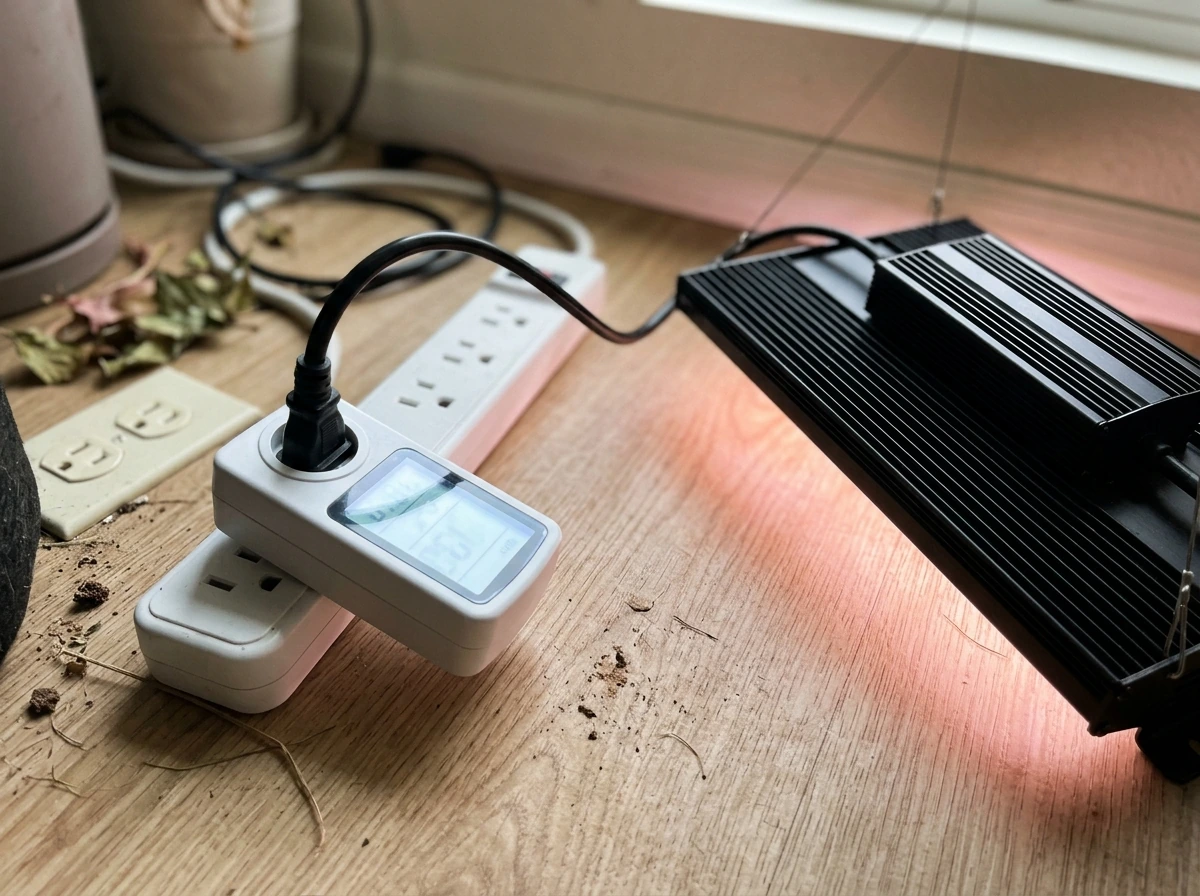
First confirm draw wattage with a plug-in meter, then verify your mounting height and whether the fixture is at the output level assumed in the marketing data. If PPFD is still low, contact the brand with the model number and ask for third-party testing for your exact configuration. If you have already missed your return window, the realistic options are increasing hang adjustment and dimming calibration carefully, but do not attempt to “solve” low output by pushing far above safe temperatures.
Next Articles
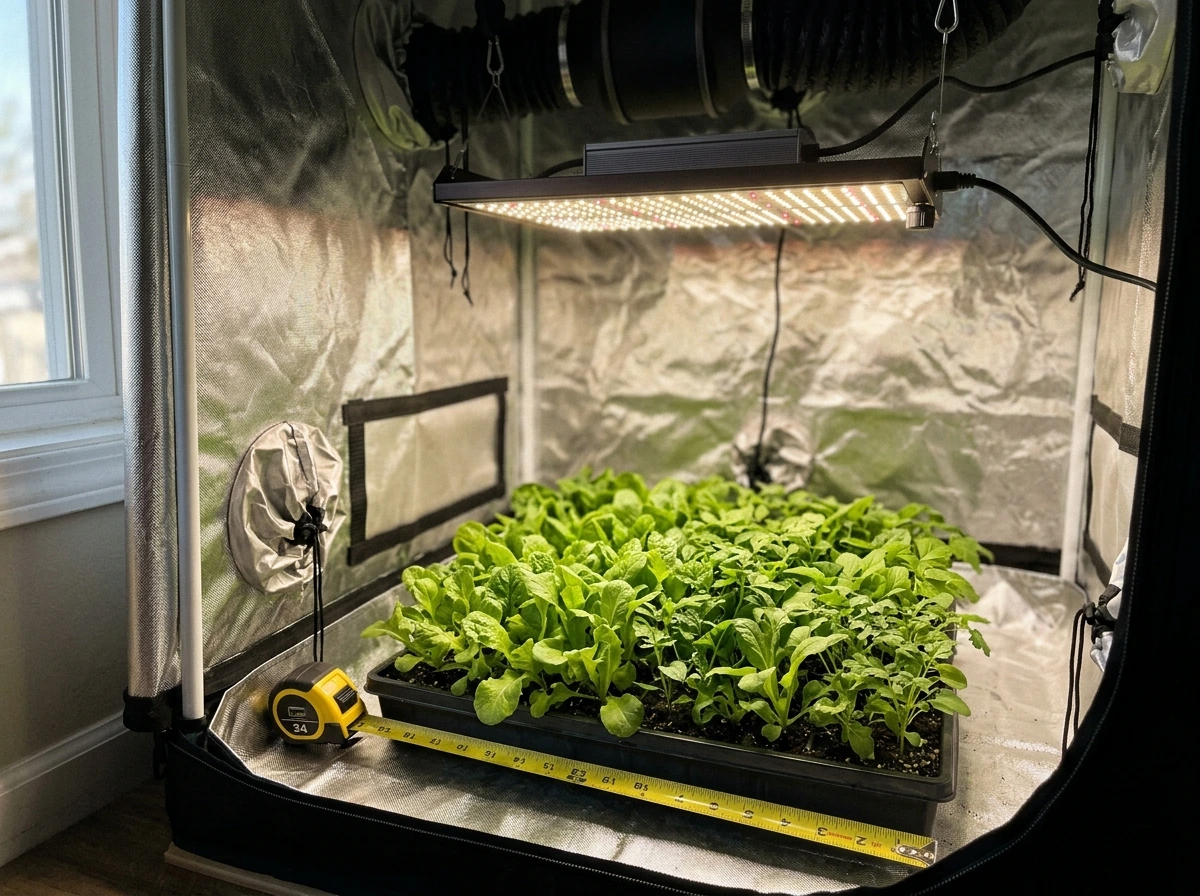
Best LED Plant Grow Light: Buying Guide by Grow Space
Best LED grow light buying guide by grow tent size: PPF/PAR specs, coverage, spectrum, dimming and plant match.
Top LED Grow Lights 2020 Buying Guide for Today
Top LED grow lights 2020 guide: pick the right spectrum, coverage, and wattage for tents or multi-panel setups.
Top LED Grow Lights 2022: Buyer Guide by Space and Stage
Buy top LED grow lights from 2022 using PPFD, coverage, spectrum, efficiency, and setup tips for each grow space size.